

Hydraulic and Wave Aspects of Novorossiysk Bora
22-04-2014
Anna A. Shestakova, Konstantin B. Moiseenko, and Pavel A. Toropov
Abstract
Bora in Novorossiysk (seaport on the Black Sea coast of the Caucasus) is one of the strongest and most prominent downslope windstorms on the territory of Russia. In this paper, we evaluate the applicability of the hydraulic and wave hypotheses, which are widely used for downslope winds around the world, to Novorossiysk bora on the basis of observational data, reanalysis, and mesoscale numerical modeling with WRF-ARW. It is shown that mechanism of formation of Novorossiysk bora is essentially mixed, which is expressed in the simultaneous presence of gravity waves breaking and a hydraulic jump, as well as in the significant variability of the contribution of wave processes to the windstorm dynamics. Effectiveness of each mechanism depends on the elevated inversion intensity and mean state critical level height. Most favorable conditions for both mechanisms working together are moderate or weak inversion and high or absent critical level.
1. Introduction
Downslope windstorms manifest itself in the wind speed increase, sometimes up to nominal hurricane force, on the leeward slopes of the mountains. Investigation of downslope winds has become widespread in the world. At the moment, the most studied downslope windstorms are the Adriatic bora (Jurčec 1980; Grisogono and Belusic 2009), the winds of the Rocky Mountains in USA, including the Chinook (Brinkmann 1974; Klemp and Lilly 1975) and the Alpine foehns (Jiang et al. 2005; Hoinka 1985).
In Russia, the greatest attention is traditionally paid to the Novorossiysk bora, due to its relative strength and destructive consequences, as well as the high population density of this region. Moreover, Novorossiysk is the largest harbor in Russia, and this is the reason of increased demand for a high-quality forecast of the phenomenon. Along with the statistical and synoptic analysis of the Novorossiysk bora, analytical models describing this phenomenon were also proposed (Gutman and Frankl 1960), as well as forecast methods based on empirical relationships of downslope velocity amplification with a large-scale atmospheric state (Bukharov et al. 2010). The results of numerical modeling using modern mesoscale atmospheric models are given in recent works (Blinov et al. 2013; Efimov and Barabanov 2013; Gavrikov and Ivanov 2015; Toropov and Shestakova 2014a, b; Toropov et al. 2012).
At present, two theoretical approaches based on simplified models of dynamic interaction of flow with terrain are broadly used to describe the phenomenon.
The wave hypothesis of the downslope winds formation is based on the two-dimensional models of stratified fluid (see detailed reviews Queney et al. 1960; Smith 1979; Kozhevnikov 1999). According to this approach, downslope wind amplification is a consequence of internal gravity waves (IGW) intensification over the mountains (Klemp and Lilly 1975), and in nonlinear models, wind amplification is related to wave breaking (Lin and Wang 1996; Peltier and Clark 1983). Wave perturbations appear in the vertical and horizontal velocities, temperatures, and pressures. There is a pressure growth on the windward slope and its drop on the leeward slope due to wave dynamics, and this pressure difference forms a force named wave drag. Together with the flow blocking by the mountains and boundary layer separation, the wave drag is a part of the orographic drag (i.e., the force of the pressure drag directed normally to the ridge). Together with surface friction, orographic drag forms the so-called total drag. The relationship between downslope windstorms and the magnitude of the wave drag has been demonstrated in many studies (Scinocca and Peltier 1993; Klemp and Durran 1987; Clark and Peltier 1984; Wang and Lin 1999b; Durran 1986). The transition from a low (linear) wave drag state to a high-drag state occurs usually sharply, which is associated with the appearance of IGW breaking zone (Peltier and Clark 1979). The greatest increase in wind speed and drag is predicted precisely by the nonlinear wave models (Clark and Peltier 1984).
Within the framework of the hydraulic approach, the solution is constructed on the basis of shallow water equations. Downslope wind amplification in this approach is associated with the transition from the subcritical (slow and deep flow) to the supercritical (fast and shallow flow) state above the lee slope with the appearance of a hydraulic jump downstream (Long 1954). Numerous studies (e.g., Durran 1986; Klemp and Durran 1987; Vucetic 1993) confirm the correctness of the use of hydraulic models for real atmospheric situations, including downslope windstorms.
In this regard, we propose an application of the hydraulic and wave approaches to the Novorossiysk bora, that is best provided with observational data in comparison with other downslope winds in Russia (such as Novaya Zemlya bora, Pevek windstorm, Kizel bora). Clarification of the mechanisms of the formation of this phenomenon will assist one to produce a physically based and more accurate bora forecast, which nowadays is made using the synoptic method. The main purpose of this study is to explore the applicability of the wave and hydraulic hypotheses to the Novorossiysk bora, and to quantify the contribution of wave processes to bora dynamics. To perform this task, we consider different aspects of the phenomenon on the basis of observations data in this region and numerical modeling with the WRF-ARW model.
- 2 -
2. Data and Methods
2.1. Observational Data
Novorossiysk bora occurs on the Black Sea coast of the Caucasus in the area between Russian cities Anapa and Tuapse with maximum intensity in the Novorossiysk and Gelendzhik regions (an example of the spatial distribution of wind speed during bora according to the WRF-ARW simulation is presented in Fig.1b). The wind speed increases when the airflow crosses two parallel coastal ranges—the Main Caucasus and the Markhot—elongated from the north-west to the southeast and havi ng maximum altitudes about 500 m in the Novorossiysk area and about 700 m in the Gelendzhik area (Fig.1b). In this research, we use observations at meteoro- logical stations of the Russian Hydrometeorological Service net—Krymsk (on the windward side), Gelendzhik, and Novorossiysk (on the leeward side) (see Fig.1b). Measurements of the main meteoro- logical parameters are carried out every 3 h at 2 m above the ground level (AGL); measurements of the wind are carried out at 10 m AGL. We consider the 12 strongest bora episodes of the last 40 years, in which the average 10-min wind speed exceeded 30 m/s. To study the incoming flow, we take the wind and temperature vertical profiles on the windward side of mountains from the National Aeronautics and Space Administration Modern Era Retrospective Analysis for Research and Applications (MERRA). This reanalysis has a high spatial resolution (0.67° in longitude and 0.5° in latitude), as well as vertical resolution (72 vertical levels instead of 52 levels in the National Centers for Environmental Prediction (NCEP) Final (FNL) analysis), and contains more observational data than model analysis, such as NCEP FNL (Carvalho et al. 2014). Finally, MERRA has a large time coverage (from 1979 to present) that overlaps with all the considered bora episodes. The need for reanalysis is determined by the sparse radiosonde observations network. To choose the reanalysis grid node in which the state of the incoming flow will be analyzed, the Rossby defor- mation radius LR = Nhm/f (N is the Brunt–Väisäla frequency, hm is the characteristic height of the ridge, f is the Coriolis parameter) is used to characterize the distance at which the effect of blocking on the windward side can be found (Belusic et al. 2004; Markowski and Richardson 2010). Subst ituting typ- ical values of hm = 500 m, f = 1 x 10⁻⁴ s-1 and stratification in the lower layer N = 0.005–0.01 s-1, we obtain LR = 30–50 km. Thus, we chose a point that is moved away from the ridge at a distance greater than LR, so that the incoming flow is not disturbed by the mountains, but simultaneously representative, that is not too far from the ridge. The location of the point is shown in Fig.1b by a cross.
Previously, the MERRA reanalysis was verified by radiosounding data of the nearest station on the windward side, that is Rostov-on-Don (Fig.1a), about 300 km to the north-east from Novorossiysk. For this purpose, we use the MERRA grid node, nearest to the station. Mean absolute error of reanalysis for wind speed is 2 m/s, for temperature is about 1.5 °C, for sea-level pressure is 0.3 hPa, and the correlation coefficients are 0.9 for wind speed and temperature and 0.99 for pressure. The reanalysis reproduces the low-level jet, thought underestimating the maximum wind speed in it (Fig.2b), and correctly reproduces quantitat ive characteristics of temperature stratificati on and elevated inversion (Fig.2a), allowing us to use MERRA reanalysis in this research.

Fig. 1 a and b
A Scheme of typical large-scale sea-level pressure distribution (contours, every 5 hPa, low and high pressure centers are marked with letters L and H, respectively) during Novorossiysk bora (composite of all 12 bora episodes); color shows terrain height [m above mean sea level (AMSL)]. WRF-ARW domains (d01, d02, and d03) are also shown. b Example of spatial distribution of wind speed at 10 m AGL according to WRF-ARW modeling in the inner domain d03 during bora. Weather stations of RHS are marked with triangles; MERRA grid point used for incoming flow analysis is marked by a cross
- 3 -
2.2. Numerical Experiments
Numerical simulation using the mesoscale WRFARW model is actively involved in this work. The use of numerical modeling is necessary because of the lack of both data on the vertical structure of the phenomenon over the mountains and measurements of mesoscale perturbations of meteorological fields at the surface along the entire cross-section of the ridges. The results of numerical modeling allow us to calculate such important features of flow over ridges as orographic and wave drag, because their relation indicates the contribution of wave processes to the formation of bora. WRF-ARW model successfully reproduces Novorossiysk bora, as demonstrated previously by us (Toropov and Shestakova 2014a, b; Toropov et al. 2012) and other authors. For example, the model error (bias) of wind speed for the test experiment is ± 5 m/s in 70% of sample, and there is no systematic error. Comparison with the extended network of meteorological measurements in the region revealed the fact that the model adequately reproduces the spatial structure of the phenomenon.
Three numerical experiments were run to simulate bora episodes on January 26–28, 2012, January 29 – February 3, 2014, and March 9–11, 2014. Simulations are performed for three nested domains (Fig.1a) with horizontal grid spacing 15 km, 3 km, and 600 m. We used pre-selected parametrization settings that are the most optimal for Novorossiysk bora modeling (see Toropov and Shestakova 2014a, b for more details). The simulation results proved to be the most sensitive to the choice of boundary layer parametrization (Toropov and Shestakova 2014a, b), in the current research, we used the Mellor–Yamada– Nakanishi–Niino level 2.5 planetary boundary layer scheme, as in our previous studies. Initial and boundary conditions in WRF-ARW runs were taken from NCEP FNL with a horizontal resolution of 1°. WRF simulations with this analysis demonstrate a more close agreement with observational data compared to WRF runs with MERRA reanalysis (Carvalho et al. 2014). WRF successfully reproduce the flow structure in Rostov-on-Don for the modeled episodes (Fig.2), including elevated inversion and low-level jet stream.

Fig. 2
Vertical profiles of wind speed (a) and temperature (b) in Rostov-on-Don, averaged throughout the bora episodes January 26–28, 2012, January 29–February 3, 2014 and March 3–11, 2014: observational data (black line), MERRA reanalysis (magenta line), and WRF model (green line). Confidence intervals of values equal to 2σ, where σ is standard deviation, are also shown
3. Results and Discussion
3.1. Incoming Flow and Blocking
Thermal structure of the incoming flow in all bora episodes is similar. In all cases, there are well-defined lower relatively unstable laye r (form surface up to 500 m) and a layer of elevated inversion above which the temperature gradient in troposphere is close to the moist-adiabatic lapse rate (Fig.3b). The tropopause is always located above 10 km. The average temperature gradient in the inversion for the culmination phase of bora is 1.1 K per 100 m and can reach 2 K per 100 m (Table 1). The height of the inversion bottom at the beginning of bora and in culmination stage changes insignificantly (Fig.3b).
For all bora episodes, a local wind maximum, associated with low-tropospheric jet stream (LTJ), is observed at altitudes 0.5–1.5 km AGL. In most of the cases, it is situated inside the inversion layer, at mean altitude 600 m AGL (Table 1). LTJ and inversion layer are situated at altitudes close to mountains top hm. Wind speed in LTJ can attain 29 m/s.
An essential feature is the change of the wind direction from the north-east in the lower troposphere to the north-west in the middle troposphere and south-west in higher layers. The height of the wind reversal H 0 (where the velocity component perpen- dicular to the ridge becomes negative) is 6–7 km for culmination stage (Table 1). In some cases, there is no wind reversal, i.e., the north-east wind blows throughout the troposphere and the lower stratosphere.
During bora, the flow blocking is observed on the windward side of the mountains. It is expre ssed in the flow stagnation near the windward slope, as well as in the increase in the difference in potential temperature Δθ between the leeward and windward side. However, at the culmination stage, Δθ (and hence the blocking strength) usually decreases compared to that in the initial stage of bora (Fig.4), which indicates a rapid propagation of the cold air mass over the ridges. Unfortunately, there is no statistically significant relationship between the value of Δθ and the downslope wind speed u d in Novorossiysk, wind speeds in the range from 10 to 40 m/s can be accompanied by Δθ from 0 to 5 K.
Novorossiysk bora develops during ultra-polar processes, on the southern periphery of low anticyclone, and/or in the rear of cyclone above the Black Sea and the Anatolian peninsula (Fig.1a). Thus, the occurrence of flow blocking is favored by synoptic situation, since the wind has a north or north-eastern direction, and the incoming air is cold and usually bounded from above by an elevated inversion.
As can be seen in Fig.4, for the same bora episodes, Δθ in Gelendzhik is much larger (approximately 2–3 times) than in Novorossiysk, which is associated with a higher ridges altitude in the Gelendzhik area. For instance, the maximum value of Δθ on January 26–28, 2012 for Gelendzhik reached 15 K, whereas for Novorossiysk—7 K. This difference appears during bora, but it is insignificant during no-bora periods (Fig.4).
The thickness of the blocking layer Zb, computed from the height of the isentrope on the windward side (in Krymsk), corresponding to the potential temperature at the surface on the leeward side of the ridge (in Novorossiysk), is on average 300 m (for the whole sample). As the bora develops, in the second half and at the end of the episodes, the blocking thickness (or blocking height) decreases [at culmination stage, it is on average 180 m (Table 1)].
- 4 -
Given the obtained information about the structure of the incoming flow, we are able to consider the applicability of the hydraulic and wave hypotheses for the Novorossiysk bora.

Fig. 3
Mean vertical profiles of cross-ridge wind component (positive when the wind direction is north-east) (a), temperature (b), and potential temperature (c) in the incoming flow for the beginning (blue dashed line) and culmination (red solid line) of bora episodes according to reanalysis. Confidence intervals of values equal to 2σ, where σ is standard deviation, are also shown
Table 1
Mean, minimal, and maximal values of the incoming flow characteristic for all considered bora episodes in culmination stage (one synoptic time per episode): Hinv height of the inversion bottom, Dhinv thickness of inversion, cinv vertical temperature gradient in the inversion layer, Umax LTJ wind speed, Hmax height of LTJ, H0 height of wind reversal, Zb blocking thickness
| Hinv(m) | Dhinv(m) | γinv(Κ/100 m) | Umax(m/s) | Hmax(m) | H0(m) | Zb(m) | |
| Mean | 510 | 800 | 1.1 | 22.3 | 595 | 6610a | 180 |
| Min | 155 | 220 | 0.2 | 17.6 | 335 | 2610 | 0 |
| Max | 980 | 1280 | 2.0 | 28.6 | 980 | >16,000 | 600 |
a Mean height of wind reversal is calculated in the lowest 16-km layer
3.2. Hydraulic Model
Several conditions are crucial for a single-layer hydraulic model, the strictest of which is the presence of density discontinuity (a layer of strong elevated inversion in the atmosphere) between the lower flow and the overlying unperturbed atmosphere. The height of the interface is one of the key parameters that determine the properties of the solution in hydraulic model. According to Klemp and Durran (1987), stronger inversions (with a large temperature gradient γ) located near the top of the ridge lead to a hydraulic jump formation and a significant increase in wind speed on the leeward slope, while for higher or lower inversion, the wind amplification is less and the region of the highest velocities is shifted to the top of the ridge. Vosper (2004) showed that the inversion intensity has a qualitative effect on the flow pattern (with other things being equal, in the presence of strong inversion, an analog of the hydraulic jump occurs, and for the weaker one, there are lee waves).

Fig. 4
Observations of 10-min averaged wind speed (m/s) in Novorossiysk (dashed line) and potential temperature difference Δθ (K) between windward side (Krymsk) and leeward side (in Novorossiysk, blue line, and Gelendzhik, pink line) of the ridges on January 18–February 24, 2012. Gray areas denote bora episodes
An analysis of incoming flow shows that its main properties can be generally considered in the framework of a single-layer stationary hydraulic model. Indeed, a layer of elevated inversion, which is a natural analog of the free interface in hydraulic approach (Klemp and Durran 1987; Vucetic 1993), is always observed during bora. When specifying the incoming flow parameters within the framework of a single-layer model, the environmental wind velocity is assumed independent of height and equal to its average value in the layer below the inversion top (Klemp and Durran 1987).
Here, we examine the results of the single-layer hydraulic Long model (Long 1954; Houghton and Kasahara 1968), adapted to the atmospheric conditions in (Klemp and Durran 1987). Following (Klemp and Durran 1987), we consider a flow with a constant velocity U0 and an upper boundary at a height Hi that coincides with the height of the inversion top.
The initial equations of a single-layer hydraulic model are written as follows (Houghton and Kasahara 1968):
| (1) | ||||||||||||
|
where u—horizontal velocity, H—flow thickness, and h=h(x)—terrain height. Axis x is directed perpendicular to the ridge. At time t=0, in the region – ∞ < x < + ∞, u=U0, H=Hi. Next, we consider the asymptotic solution of system (1), which becomes stationary for t » 0.
- 5 -

Fig. 5
A Scheme of flow regimes in the phase space of Fri–M according to one-layer hydraulic model (1) (adopted from Baines 1987). b Same diagram for all considered Novorossiysk bora episodes when the wind speed > 15 m/s. Red squares denote cases with a strong elevated inversion (i.e., with a vertical temperature gradient > 1.5 K/100 m) and black squares denote cases with weaker inversions. Roman numbers denote areas corresponding to different flow regimes: I—everywhere subcritical, II—verywhere super critical, III—total flow blocking, and IV—Transition from subcritical to supercritical regime over the leeward slope with the formation of propagating (a) and stationary (b) hydraulic jump
The solution of this nonlinear system can easily be depicted in the phase space of the dimensionless numbers Fri–M, which determine the regime of flow over ridge depending on the conditions in the incoming flow (Fig.5a). Dimensionless numbers are determined by the formulas:
Fri = U0 /√g'Hi shallow-water Froude number,
(2)
M = hm /Hi dimensionless height;
(3)
where g' = gΔθi/θ0—buoyancy parameter, Δθi—potential temperature gradient in the inversion layer, and U0 and θ0 are averaged for the layer from surface up to Hi.
The diagram (Fig.5b) demonstrates the solution in the phase space Fri–M for all considered cases, when the 10-min averaged wind speed in Novorossiysk > 15 m/s and the wind reversal level H0 is higher than Hi. Cases with strong inversion, when γ exceeds 1.5 K/km, are highlighted with red squares. To avoid the uncertainty, associated with the insufficient accuracy of the inversion boundaries determination in reanalysis (that have a relatively low vertical resolution), we calculated the Fri and M for the lowest and highest possible inversion boundaries position.
In accordance with the general properties of the solution of the shallow water Eq. (1), the phase space is divided into sub-regions corresponding to the following conditions: subcritical flow behind and above the obstacle (I), everywhere supercritical flow (II), complete blocking of the flow (III), and partial blocking with flow transition from subcritical to supercritical over the lee slope and downward propagating (IVa) or stationary (IVb) hydraulic jump on the lee side. For a given Fri, transformation to regime with a hydraulic jump (II → IVa, I → IVb) occur when M reaches the critical value Mc (Fri). The interface between regimes I, II, and IVa, b (the solid lines in Fig.5a, b) is determined from the following equation (Houghton and Kasahara 1968):
| (4) |
The regime of complete flow blocking arises under the condition (Houghton and Kasahara 1968):
| [(M - 1)/M]√M(1+½M) = Fri | (5) |
The line, dividing the regions IVa and IVb, corresponds to the conditions under which the velocity of hydraulic jump is zero and the jump is stationary directly at the foot of the lee slope (within the region IVb, a stationary jum p occurs above the lee slope).
- 6 -
The absolute majority of points in the diagram are related to the hydraulic jump solution (Fig.5b). According to Fig.5b, the nonstationary, i.e., propagating downstream, and stationary (near the foot or above the lee slope) hydraulic jump are both typical for Novorossiysk bora. The regime of propagating jump means that the supercritical regime, which corresponds to high wind speed, can propagate further from the obstacle (Fig.5a). Wind amplification (ratio of downslope wind speed ud to the incoming flow velocity U0) predi cted by the hydraulic model increases in the direction from the upper left corner of Fig.5b to the lower right (Houghton and Kasahara 1968) and in the right part of region IVb reaches 3–3.5.
For cases with weaker inversions, the hydraulic model sometimes predicts a subcritical or supercritical flow regimes (I and II), while for cases with strong inversion, it always predicts a regime with a hydraulic jump (or very close to it) (Fig.5b). We can conclude that for the consider ed events, a single-layer hydraulic model stably simulates the flow regime that corresponds to wind speed amplification on the lee side of the ridge (under flow regimes I, II, and III, such wind amplification does not occur). Similar results were obtained earlier for the Adriatic bora (Pettre 1984; Vucetic 1993), which can indicate the akin mechanisms of significant wind amplification in these regions.
In our numerical experiments with the WRFARW model, there are structures resembling a hydraulic jump on the lee side of Markhot range (Fig.6)—namely, an abrupt change in the isentropes height, accompanied by a decrease in the surface wind speed downstream of the jump and wind amplification on the lee side upstream of the jump. The change in the isentropes height can reach 2 km (Fig.6). On average, the hydraulic jump is located in the first kilometers (1–5 km) from the lee slope, but its position most often varies during the episode. As the bora develops, the jump propagates downstream, and when bora decays, it moves upstream; in the initial or final stages, the jump may be located above the lee slope. Sometimes, there is a boundary layer separation and rotors below the area of hydraulic jump (Fig.6).
3.3. Wave Aspects
At the same time, the predominance of stable stratification in the atmosphere is a favorable condition for the appearance and propagation of internal gravity waves (Gill 1982). Wave models are based on the system of equations of motion, heat, and continuity, describing the behavior of the flow over the ridge of a given profile in the X–Z plane. Typically, the model is divided into several layers, in which the characteristics of incoming flow are constant with height (Klemp and Lilly 1975; Peltier and Clark 1979; Wang and Lin 1999a).
Linear models in some cases allow one to obtain an analytical solution (Klemp and Lilly 1975). However, even in the most simplified configuration, this task seems quite complicated in compari son with a single-layer hydraulic mode l. Recently, numerical atmospheric models based on primitive equations are often used to study waves in the atmosp here (e.g., (Jiang et al. 2005; Gohm and Mayor 2005; Gohm et al. 2008). Therefore, we consider only certain aspects of the phenomenon in the framework of wave approach, which can be estimated from observations, reanalysis, and numerical modeling, such as the linearity of the wave processes, the wave drag behavior, and dependence of nonlinear wave pro- cesses on inco ming flow characteristics.
IGW are linear when internal Froude number Frm = U/Nhm [ratio of flow velocity to gravi ty waves velocity score (Gill 1982)] is greater than critical value. Critical value of the Froude number is on average close to unity, but can vary depending on the shape of the mountain (Lin and Wang 1996; Stein 1992). Nonlinearity occurs when Frm < 1 (i.e., when wave perturbations are too big compared to flow velocity). Here, nonlinearity means nonlinear growth of wave steepness that leads to sharp gradients of meteorological fields (Markowski and Richardson 2010). Such effects occur in mode ls that do not involve equations lineariz ation. The main manifesta tions of nonlinearity in the aforementioned sense are the formation of a flow-blocking zone on the windward side and a zone of wave breaking above the ridge (Lin and Wang 1996). Downslope wind- storms are typically characterized by the regime of nonlinear wave processes (Belusic et al. 2004; Durran 1986; Jiang et al. 2005).
At very small values of Frm, the blocking is very large; the blocking thickne ss increases with decreas- ing Froude number (Stein 1992). According to laboratory experiments (Rothman and Smith 1989), the maximum downslope wind speed amplification occurs at Frm from 0.6 to 1 and exceeds 2–2.5. In general, nonlinear effects appear earlier with a decrease of Frm (Lin and Wang 1996), and the height of the upper boundary of the wave breaking zone increases (Rothman and Smith 1989; Stein 1992).
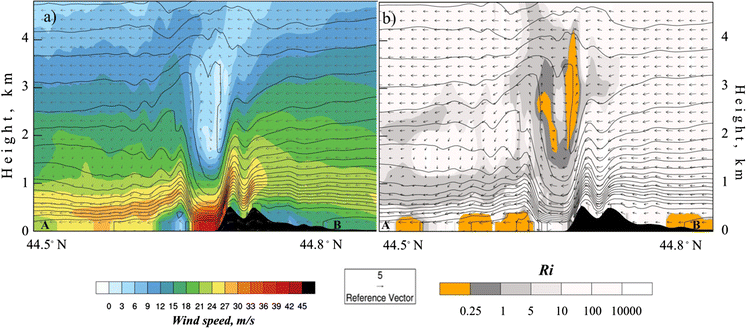
Fig. 6
Cross-section AB (the line is shown in Fig.1b) of wind speed (a) and Richardson number (b) at 03UTC 27 January 2012. Contours show potential temperature (K, every 2 K), vectors show the wind in X–Z plane (u and w components of the wind, where u is the component, perpendicular to the ridge). The incoming flow is from right to left
- 7 -
Unfortunately, it is impossible to accurately determine the linearity/nonlinearity of the expected wave processe s for the investigated episodes of Novorossiysk bora, since the characteristics of the incoming flow are variable in time and in height. However, the occurrence of partial flow blocking is proved by observations (see Sect. 3.1), and this is a partial confirmation of the presence of nonlinear processes. Moreover, the values of internal Froude number (calculated from the mean wind speed and Brunt–Väisäla frequency in the layer below H0) for the Novorossiysk bora at the culmination stage vary within 0.7–1.5, which overlaps the range of Frm with maximum wind speed amplificat ion (Rothman and Smith 1989). Thus, the wave model of phenomenon predicts that the wave breaking will dominate the flow blocking (as previously shown, blocking decreases with the bora development), and that the downslope wind speed during bora will amplify significantly.
Numerical modeling shows that for all the modeled episodes, a well-mixed layer with the wind speed close to zero and local Richardson number Ri close or less than 0.25 appears in the lower troposphere over the lee slope or somewhat downstream (Fig.6a,b), indicating the occurrence of wave breaking (Wang and Lin 1999a). This layer is called self-induced critical level [the critical level for orographic waves corresponds to the altitude at which the cross-ridge wind component is zero (Markowski and Richardson 2010; Gill 1982)]. The height of the self-induced critical level for considered episodes varies within wide limits — from 1 to 4 km. Mean state critical level at the wind reversal height is also present for most episodes of bora and appears in the incoming flow due to large-scale factors.
All these features of the flow pattern over and near the rid ges (wave breaking, hydraulic jump, and blocking) indicate significant flow nonlinearity in most of the cases, which was predicted by the Froude number calculations.
To quantitatively evaluate the wave activit y during bora and the contribution of wave processes to the overall dynamics, we use wave drag and wave stress. The relationship between wave activity, manifested in wave drag, and a strong wind on the leeward slope in different regions was reve aled on the basis of both observational data and simulation results (Scinocca and Peltier 1993; Clark and Peltier 1984; Durran 1986).
In the absence of high-precision mea surements of pressure and velocity along the whole cross-section of the ridges, we evaluated the wave on the basis of numerical simulation results.
The wave stress is defined as follows:
| τw(z) = –ρ(z)u'w' | (6) |
The overbar means horizontal averaging across the ridge. The vertical momentum flux associated with waves in a two-dimensional approximation (when the problem is considered in the X–Z plane, and in the Y direction, the length of the ridge is assumed to be infinite) is defined as follows:
| (7) |
where L is the ridge length along the X-axis. The vertical momentum flux near the surface is equal to the wave drag (with the opposite sign), that is
| MF(0) = –Dw, | (8) |
where the wave drag Dw is a part of orographic drag D, defined as follows:
| (9) |
The average pressure drop between the windward and leeward side that results from the wave drag can be estimated as follows (Smith 1985):
| Δp = Dw/hm | (10) |
Integrals (7), (9) were approximated by sums; summation and averaging were performed directly above the ridge along the X-axis directed perpendic- ular to the ridge. The wave stress and the vertical momentum flux were calculated at each model level; wave drag was calculated using relation (8). Wave perturbations could be calculated by different meth- ods. In the current research, we obtained velocity and pressure perturbations by subtracting the average flow state retrieved from the outer model grid (i.e., u' = u(d03) - (d01)). We chose this method because of its simplicity and relatively high resolu- tion of inner model grid that allows resolving IGW explicitly. Moreover, it is well known that the main source of perturbations during downslope windstorms is gravity waves (Smith 1978). Other processes, producing drag in mountainous regions, are flow blocking and flow separation on the lee side. However, the latter is not presented during modeled bora episodes in our simulations. To avoid inaccuracies associated with flow blocking, calculations of the wave stress and the vertic al momentum flux were performed only above the blocked layer. Such approach is correct, since the source of IGW can be either the earth surface or the surface that coincides with the first isentropic surface that rise to the mountain top (i.e., Zb) in the case of blocking (Lott and Miller 1997). In the blocked layer, the values of wave stress were assumed constant and equal to those at the blocking height (that is, τw(0) = τw(Zb)).
The average and maximum values of the wave drag and stress at the surface calculated from the results of numerical modeling are shown in Table 2. For ordinary conditions (in the absence of extreme winds), the wave stress calculated from measure- ments of the surface pressure in the mountainous regions usually does not exceed 1–6 N/m2 (Smith 1978; Hoinka 1984, 1985). The surface wave stress during, for example, Boulder windstorm is of the order of 101 N/m2 (Lilly 1978), as for the Novor- ossiysk bora according to our estimations (Table 2). The maximum values of the surface wave stress exceed mean wave stress by a factor of 5 (Table 2).
- 8 -
The magnitude of pressure difference between the windward and leeward slope, connected to wave processes over the mountains (Table 2), is comparable to the observed mesoscale pressure difference. According to observations, the average sea-level pressure difference ΔP between the windward and leeward sides of the ranges (pressure in Krymsk “minus” pressure in Novorossiysk) is 4.4 hPa. A part of the gradient connected with mesoscale effects (ΔPmeso = ΔP - ΔPmacro, where ΔPmacro is part of the pressure gradient connected only with large-scale atmospheric processes and is calculated from reanalysis data) at the culmination stage of bora which can reach 70% of the total gradient, that is, exceeds the contribution of synoptic processes. 12 episodes (including the beginning and final stages of the episodes) averaged mesoscale pressure difference between Novorossiysk and Krymsk is 2.9 hPa (the average for the culminating phase is 5.6 hPa), the maximum is 6.5 hPa. Thus, the wave drag could be the main source of mesoscale pressure perturbations during Novorossiysk bora.
Table 2
Mean and maximal wave stress, pressure difference, mean wave drag, orographic drag at the surface, and ratio of wave drag and orographic drag (± RMS) according to numerical modeling
| Mean τw(0) | Max τw(0) | Mean Dw(0) | Mean Δp | Max Δp | Mean D | Mean Dw/D |
| 3.8 N/m2 | 18 N/m2 | 0.8 x 10⁵ N/m | 1.3 hPa | 7.1 hPa | 2 x 10⁵ N/m | 0.4(± 0.37) |
The wave drag in simulated episodes of Novor- ossiysk bora is highly variable, and changes sharply during the episodes. The variability of the wave drag contribution to the orographic drag Dw/D is significant (varies from 0 to 100%); the magnitude of the root-mean square (RMS) is comparable to its mean value (Table 2). The magnitude of downslope wave speed in those cases when the contribution of wave drag is small is not connected to the magnitude of wave drag, and the wind speed in such cases can still attain 25–30 m/s.
3.4. Hydraulic and Wave Mechanisms Under Different Initial Conditions
We divide all bora cases of the three modeled episodes (model times with downslope wind speed ud > 15 m/s, totally 200 times) into g roups with low (< 2.5 km) and high (> 10 km) or absent mean state critical level and also with weak (vertical temperature gradient < 0.5 K/100 m) and strong (vertical temperature gradient <1.5 K/100 m) elevated inversion. There are no cases without inversion in the sample. Among the entire sample, 17% are with strong inversions, 23%—with weak inversions, 31%—with a low critical level, and 37%—with a high or absent critical level.
Figure 7 demonstrates examples of vertic al cross sections of wind speed according to modeling results during bora with different combinations of inversion intensity and critical level height. We chose the most typical (repetitive) patterns for each combination for Fig.7. Figure also shows scheme of wave drag regimes (e) and the hydraulic diagram (f), similar to Fig.5. Scheme (e) shows the ratio Dn of the wave drag to the linear wave drag D1 ≈ ρNUhm2 depending on the inverse internal Froude number Frm-1 (i.e., depending on the incoming flow characteristics). An analytical expression for the linear drag is obtained by substituting the profile of a bell-shaped mountain (see, for example, Eckermann et al. 2010) in the formula for the orographic drag (9) using the linear hydrostatic approximation. According to the theory, the wave drag is close to linear (i.e., the normalized drag Dn is close to unity) for values of Frm-1 less than a critical value, whi ch corresponds to regime I in Fig.7e. In this case, waves freely propagate in the vertical direction and usually have small amplitudes. During downslope windstorms, another regime is usually observed, which is characterized by nonlinear processes, lowlevel wave breaking, when the wave drag is several times greater than the linear drag (Scinocca and McFarlane 2000). This regime (II in Fig.7e) usually occurs when Frm-1 is in range 0.5–1.5 (critical values of Froude number vary depending on model or parametrization used). For instance, the fastest transition from linear waves to nonlinear processes (characterized by high wave drag) in Durran (1986) occurs when Frm-1 increases from 0.2 to 0.6. With further growth of Frm-1, the wave energy is blocked and does not propagate from the surface (regime III in Fig.7e).
For cases with low mean state critical level, the wave stress is usually low and in average is 2 N/m2, although in 3% of cases, it attains 10 N/m2. For cases with high critical level, dispersion of wave stress values is very large, it changes from 0 to 23 N/m2, and in average is 3.5 N/m2.
Inversion intensity has a much more clear effect on the flow regimes. For cases with strong inversion, wave drag is always low and the wave mechanism is never realized (average wav e stress is 0.6 N/m2, Dn = 0.1). As can be seen in Fig.7, the case with strong inversion and low critical level (case 1) is characterized by complete bloc king of wave energy (regime III in Fig.7e) and bora is maintained solely by the hydraulic mechanism (Fig.7f). Case 2 with a strong inversion and no critical level corresponds to regime II in Fig. 7e (nonlinear drag) according to incoming flow conditions, but, actually, the wave stress is even less than the linear one, i.e., the wave mechanism does not work again. On the other hand, 91% of cases with strong inversions fulfill the hydraulic mechanism, which is expressed in the appearance of a hydraulic jum p (usually stationary) and the downslope wind amplification can be very high (for instance, the ratio of leeward and windward velocities reaches 3 for case 2, which is fully consistent with the prediction of the hydraulic model).
- 9 -
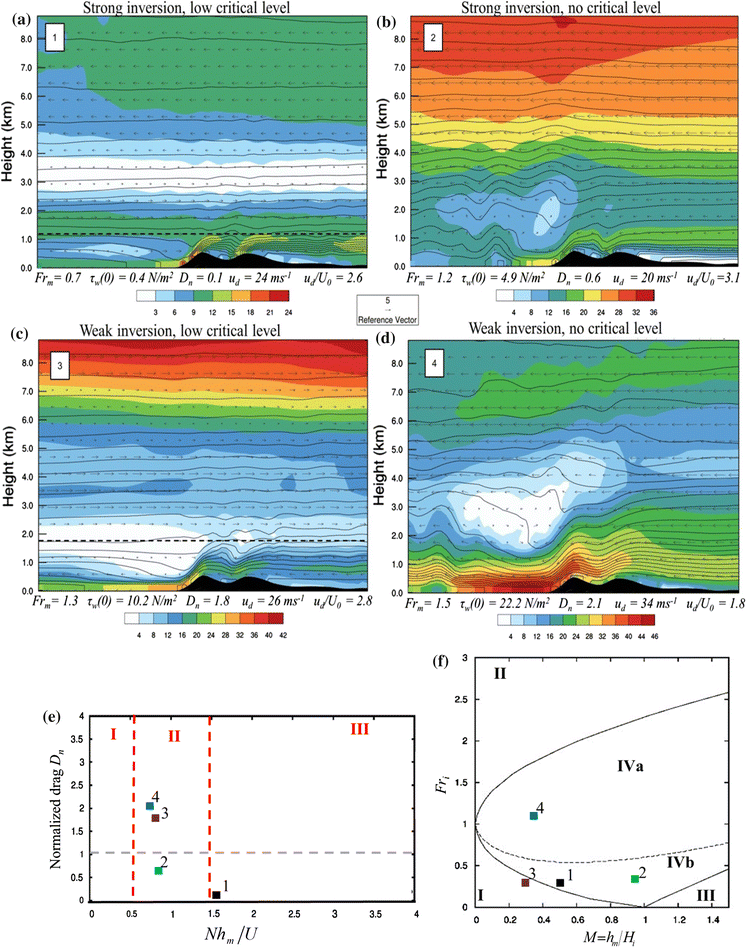
Fig. 7
Flow regimes for bora cases with different inversion intensity and mean state critical level height: a–d Cross-section AB (the line is shown in Fig.1b) of wind speed (color, in m/s) for different cases; e scheme of normalized drag behavior depending on inverse Froude number (adopted from Eckermann et al. 2010) and f hydraulic diagram (scheme of flow regimes in the phase space of Fri–M according to one-layer hydraulic model) for cases a–d. On figures a–d, contours show potential temperature (every 2 K); vectors show the wind in X–Z plane (u and w components of the wind, where u is the cross-ridge component), reference vector is 5 m/s. The flow is from right to left
- 10 -
Unlike strong inversions, weak inversions favor the wave mechanism realization in most of the cases. Wave stress for cases with weak inversions is in average 7 N/m2 and normalized drag is 1.5. Cases 3 and 4 fully correspond to the nonlinear wave regime. Hydraulic model in cases with weak inve rsions works better with no critica l level (case 4, when the solution of hydraulic model is propagating hydraulic jump), when the critical level is low hydraulic model works only in part of the cases (case 3 refers to the subcritical flow, Fig.7f). The instability of the solution of the hydraulic model for weak inversions, obtained from simulation data, coincides with the results obtained from reanalysis data (see Sect. 3.2).
The greatest wind speed and the largest perturba- tions of the isentropes among the four cases in Fig.7 appear in the case with no critical level and weak inversion (case 4). In such a combination of incoming flow parameters, both mechanisms mos t often works together, which leads to the greatest increase in perturbations.
4. Conclusions
In the current study, we investigate the applicability of hydraulic and wave approaches for the description of Novorossiysk bora mechanisms using observational and reanalysis data, and numerical modeling.
Analysis of the incoming flow structure for all the considered bora episodes shows the potential possibility of applying both the hydraulic and wave model of the phenomenon.
The hydraulic model predicts the appearance of a transition of the flow regime from subcritical to supercritical over the leeward slope and a hydraulic jump on the leeward side for almost all episodes. Structures resembling a hydraulic jump, that is, a jump-like change in the height of the isentropes on the leeward side, accompanied by a decrease in the surface wind speed and turbulent energy dissipation on it, are found in numerical experiments with WRF model.
Wave model in most of cases predicts the predominance of nonlinear effects—the wave breaking on the lee side and the partial blocking of the flow on the windward side. The results of numerical simulation and observations confirm the mean features of flow pattern in wave model.
Estimation of the wave drag based on the results of numerical simulation showed that the mechanism of formation of Novorossiysk bora is essentially mixed. In all the cases with a strong elevated inversion contribution of wave processes to bora formation is near-zero, and high wind speeds in these cases are maintained by a hydraulic mechanism solely. At the same time, the wave drag sharply (nonlinearly) increases at some cases, so that the contribution of the wave drag to the orographic drag reaches 100%. Thus, the mixed mechanism of the formation of downslope winds in Novorossiysk is expressed in the simultaneous presence of gravity waves breaking and a hydraulic jump, as well as in the significant variability of the contribution of wave processes to the windstorm dynamics. Favorable atmospheric conditions for both hydraulic and wave mechanisms are the presence of a not strong inversion and a high or absent mean state critical level.
In general, both approaches contain simplifications of different strengths, so the phenomena reproduced by these models must have similar aspects. For instance, a well-known analogy can be drawn between the effects of a hydraulic jump in an incompressible fluid and the formation of a zone of IGW breaking downstream of the obstacle (Gohm et al. 2008; Klemp and Durran 1987; Smith 1985). Obviously, this is why the results of the hydraulic and wave models do not contradict, but supplement each other, which allows us to learn the phenomenon more widely.
The main limitations of this research are a small number of numerical experiments and insufficient accuracy of the wave perturbations calculation method. We believe that more experiments and the use of other methods for calculat ing wave perturbations will confirm the validity of the results obtained.
An obtained assessment of the way which the large-scale atmospheric dynamics (conditions in the incoming flow) affects mesoscale perturbations of velocity and pressure during the Novorossiysk bora within the framework of two basic approaches is a result that has some practical applications. For instance, understanding the mechanisms of interaction of the large-scale and mesoscale dynamics will help to detect and forecast the considered phenomenon using low-resolution atmospheric models or to estimate the intensit y of phenomenon in a changing climate.
Acknowledgements
The authors gratefully thank V.M. Stepanenko for helpful advices, S.A. Myslenkov for technical assistance and facilities, and O. Bulygina for providing us with observational data. This work was supported by the Russian Fo undation for Basic Research, Grant number 12-05-31508.
References
Baines, P.G. (1987). Upstream blocking and airflow over mountains. Annual Review of Fluid Mechanics, 19(1), 75–95.
Belusic, D., Pasaric, M., & Orlic, M. (2004). Quasi-periodic bora gusts related to the structure of the troposphere. Quarterly Journal Royal Meteorological Society, 130, 1103–1121.
Blinov, D.V., Perov, V.L., Peskov, B.E., & Rivin, G.S. (2013). Extreme bora of February 7–8, 2012, in the area of Novorossiysk and its forecast with the COSMO-Ru model (in Russian). Bulletin of Moscow University 5 ‘‘Geography’’, 4, 36–43.
Brinkmann, W.A.R. (1974). Strong downslope winds at Boulder, Colorado. Monthly Weather Review, 102(8), 592–602.
Bukharov, M.V., Losev, V.M., & Peskov, B.E. (2010). Automated estimation of local wind enhancement in Novorossiysk. Russian Meteorology and Hydrology, 35(2), 101–106.
Carvalho, D., Rocha, A., Gomez-Gesteira, M., & Silva Santos, C. (2014). WRF wind simulation and wind energy production estimates forced by different reanalyses: comparison with observed data for Portugal. Applied Energy, 117, 116–126.
Clark, T.L., & Peltier, W.R. (1984). Critical level reflection and the resonant growth of nonlinear mountain waves. Journal of Atmospheric Science, 41(21), 3122–3134.
Durran, D.R. (1986). Another look at downslope windstorms. Part I: The development of analogs to supercritical flow in an infinitely deep, continuously stratified fluid. Journal of Atmospheric Science, 43(21), 2527–2543.
- 11 -
Eckermann, S.D., Lindeman, J., Broutman, D., Ma, Jun, & Boybeyi, Z. (2010). Momentum fluxes of gravity waves generated by variable Froude number flow over three-dimensional obstacles. Journal of Atmospheric Science, 67(7), 2260–2278.
Efimov, V.V., & Barabanov, V.S. (2013). Simulation of bora in Novorossiysk. Russian Meteorology and Hydrology, 38(3), 171–176.
Eliassen, A., & Palm, E. (1961). On the transfer of energy in sta- tionary mountain waves. Geofysiske Publikasjoner, 22, 1–23.
Gavrikov, A.V., & Ivanov, A.Y. (2015). Anomalously strong bora over the Black Sea: Observations from space and numerical modeling. Izvestiya, Atmospheric and Oceanic Physics, 51(5), 546–556.
Gill, A.E. (1982). Atmosphere-ocean dynamics. London: Academic Press.
Gohm, A., & Mayor, G.J. (2005). Numerical and observational case-study of a deep Adriatic bora. Quarterly Journal Royal Meteorological Society, 131, 1363–1392.
Gohm, A., Mayr, G.J., Fix, A., & Giez, A. (2008). On the onset of bora and the formation of rotors and jumps near a mountain gap. Quarterly Journal of the Royal Meteorological Society, 134, 21–46.
Grisogono, B., & Belusic, D. (2009). A review of recent advances in understanding the meso- and microscale properties of the severe Bora winds. Tellus, 61A(1), 1–16.
Gutman, L.N., & Frankl, F.I. (1960). The hydrodynamic model of bora (in Russian). Reports of the Academy of Sciences USSR, 30(5), 23–37.
Hoinka, K.P. (1984). Observations of a mountain-wave event over the Pyrenees. Tellus A: Dynamic Meteorology and Oceanography, 36(4), 369–383.
Hoinka, K.P. (1985). Observation of the airflow over the Alps during a foehn event. Quarterly Journal of the Royal Meteorological Society, 111(467), 199–224.
Houghton, D.D., & Kasahara, A. (1968). Nonlinear shallow fluid flow over an isolated ridge. Communications on Pure and Applied Mathematics, 21(1), 1–23.
Jiang, Q., Doyle, J.D., & Smith, R. B. (2005). Blocking, descent and gravity waves: Observations and modelling of a MAP northerly föhn event. Quarterly Journal of the Royal Meteorological Society, 131, 675–701.
Jurčec, V. (1980). On mesoscale characteristics of bora conditions in Yugoslavia. Pure and Applied Geophysics, 119(3), 640–657.
Klemp, J.B., & Durran, D.R. (1987). Numerical modeling of bora winds. Meteorology and Atmospheric Physics, 36, 215–227.
Klemp, J.B., & Lilly, D.K. (1975). The dynamics of wave-induced downslope winds. Journal of Atmospheric Science, 32, 320–339.
Kozhevnikov, V.N. (1999). Atmospheric perturbations for flow over mountains (in Russian). Moscow: Nauchnii Mir.
Lilly, D.K. (1978). A severe downslope windstorm and aircraft turbulence event induced by a mountain wave. Journal of Atmospheric Science, 35(1), 59–77.
Lin, Y.L., & Wang, T.A. (1996). Flow regimes and transient dynamics of two-dimensional stratified flow over an isolated mountain ridge. Journal of Atmospheric Science, 53(1), 139–158.
Long, R.R. (1954). Some aspects of the flow of stratified fluids: II. Experiments with a two-fluid system. Tellus, 6, 97–115.
Lott, F., & Miller, M.J. (1997). A new subgrid-scale orographic drag parametrization: Its formulation and testing. Quarterly Journal Royal Meteorological Society, 123(537), 101–127.
Markowski, P., & Richardson, Y. (2010). Mesoscale meteorology in midlatitudes. Oxford: Royal Meteorological Society.
Peltier, W.R., & Clark, T.L. (1979). The evolution and stability of finite-amplitude mountain waves. Part II: Surface wave drag and severe downslope windstorms. Journal of Atmospheric Science, 36(8), 1498–1529.
Peltier, W.R., & Clark, T.L. (1983). Nonlinear mountain waves in two and three spatial dimensions. Quarterly Journal of the Royal Meteorological Society, 109, 527–548.
Pettre, P. (1984). Contribution to the hydraulic theory of bora wind using ALPEX data. Beitraege zur Physik der Atmosphaere, 57(4), 536–545.
Queney, P., Corby, G.A., Gerbier, N., Koschmieder, H., & Zierep, J. (1960). The airflow over mountains. In M.A. Alaka (Ed.) Technical note, №34. Geneva: WMO.
Rothman, W., & Smith, R.B. (1989). A laboratory model of severe downslope winds. Tellus, 41A, 401–415.
Scinocca, J.F., & McFarlane, N.A. (2000). The parametrization of drag induced by stratified flow over anisotropic orography. Quarterly Journal Royal Meteorological Society, 126(568), 2353–2393.
Scinocca, J.F., & Peltier, W.R. (1993). The instability of Long’s stationary solution and the evolution toward severe downslope windstorm flow. Part I: Nested grid numerical simulations. Journal of Atmospheric Science, 50(14), 2245–2263.
Smith, R.B. (1978). A measurement of mountain drag. Journal of Atmospheric Science, 35, 1644–1654.
Smith, R.B. (1979). The influence of mountains on the atmosphere. Advances in Geophysics, 21, 87–230.
Smith, R.B. (1985). On severe downslope winds. Journal of Atmospheric Science, 42(23), 2597–2603.
Stein, J. (1992). Investigation of the regime diagram of hydrostatic flow over a mountain with a primitive equation model. Part I: Two-dimensional flows. Monthly Weather Review, 120(12), 2962–2976.
Toropov, P.A., Myslenkov, S.A., & Shestakova, A.A. (2012). Numerical simulation of Novorossiysk bora and related wind waves using the WRF-ARW and SWAN models. Russian Journal of Earth Sciences, 12, ES6001. https://doi.org/10.2205/2012es000524.
Toropov, P.A., & Shestakova, A.A. (2014a). Quality assessment of Novorossiysk bora simulation by the WRF-ARW model. Russian Meteorology and Hydrology, 39(7), 458–467.
Toropov, P.A., & Shestakova, A.A. (2014b). Testing of the WRF model for forecasting the Novorossiysk bora (in Russian). Vestnik Moskovskogo Universiteta, Seriya Geographiya, 3, 23–29.
Vosper, S.B. (2004). Inversion effects on mountain lee waves. Quarterly Journal of the Royal Meteorological Society, 130, 1723–1748.
Vucetic, V. (1993). Severe bora on the mid-Adriatic. Hrvatski Meteoroloski casopis, 28, 19–36.
Wang, T.A., & Lin, Y.L. (1999a). Wave ducting in a stratified shear flow over a two-dimensional mountain. Part I: General linear criteria. Journal of Atmospheric Science, 56(3), 412–436.
Wang, T.A., & Lin, Y.L. (1999b). Wave ducting in a stratified shear flow over a two-dimensional mountain. Part II: Implications for the development of high-drag states for severe downslope windstorms. Journal of Atmospheric Science, 56(3), 437–452.
(Received September 29, 2017, revised January 31, 2018, accepted February 6, 2018, Published online February 10, 2018)


