

11-01-2026
A forensic expert on the Dyatlov Pass mystery: "If they weren't Phystech students, they'd still be alive."
Notes and recollections of Elena Koskina - part 2
January 11, 2026. All rights reserved Komsomolskaya Pravda. Authors Nikolay Varsegov and Natalya Varsegova

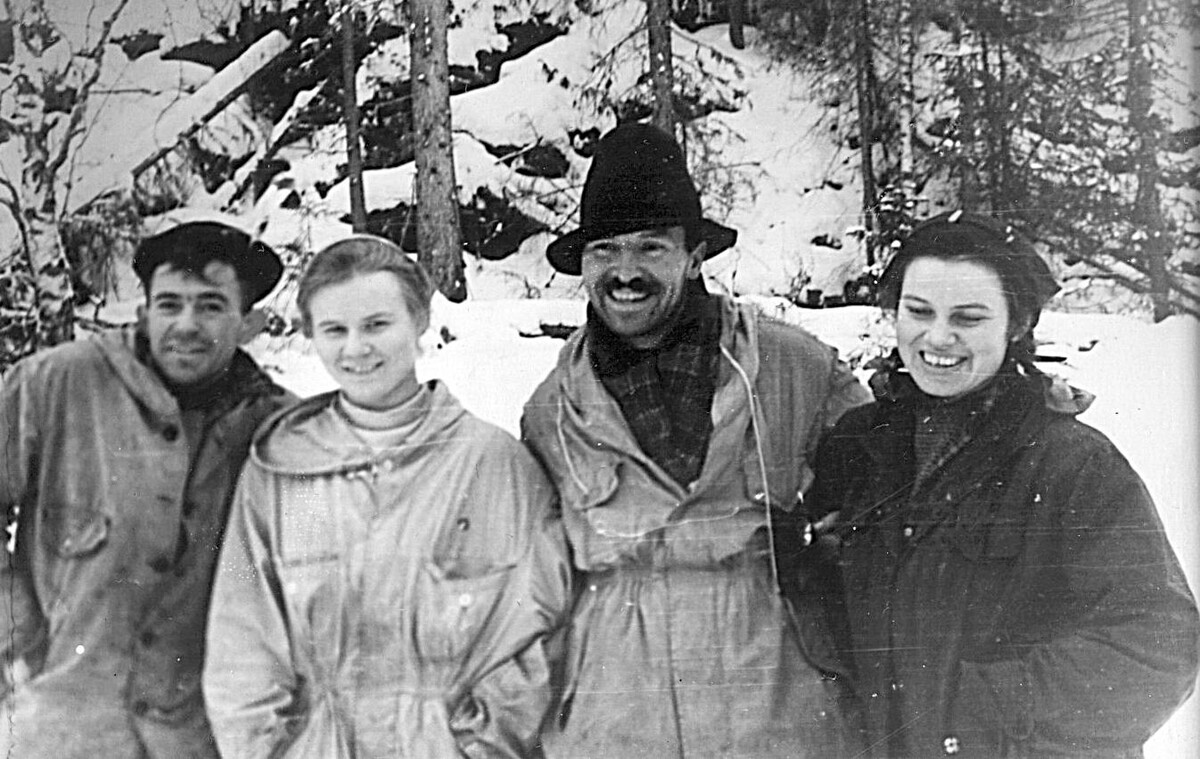
Photos from the fateful expedition: Kolya Thibeaux-Brignolle, Lyuda Dubinina, Semyon Zolotaryov, Zina Kolmogorova
In the previous part we published memories from relatives of the deceased hikers and a story about the funeral of the first five. As a reminder, Alexey Koskin, head of the Dyatlov Group Memorial Foundation, gave us a notebook belonging to his ex-wife, Elena, in which she chronicled her investigation into the hikers' deaths. From 1989 to 1999, Elena communicated with searchers and recorded their recollections of the tragic events of the winter of 1959.
We now offer the memoirs of those directly involved in the search. We are publishing the entries virtually without corrections, but with our commentary.
Where did the flashlight come from?
Boris Slobtsov, a second-year student at the Faculty of Energy, was the first to discover the Dyatlov group's tent abandoned on the snowy slope of Kholat-Syakhl:
"I was the first to approach the tent and saw a flashlight, a Chinese one. It belonged to Igor Dyatlov. What was strange was that under the flashlight, which was lying on the tent canvas on the snow, there was about 5-10 cm of snow (!). There was no snow on top of the flashlight, and only a light dusting of snow on the sides. I grabbed the flashlight first and discovered it wasn't turned on. When I turned it on, the light came on.
(Authors: The flashlight on the tent is one of the mysteries of the history of the pass. It's unclear why Slobtsov decided it was Igor Dyatlov's flashlight? We believe the flashlight appeared on the tent a day or two before student Slobtsov discovered it with its battery still fresh from the cold.)
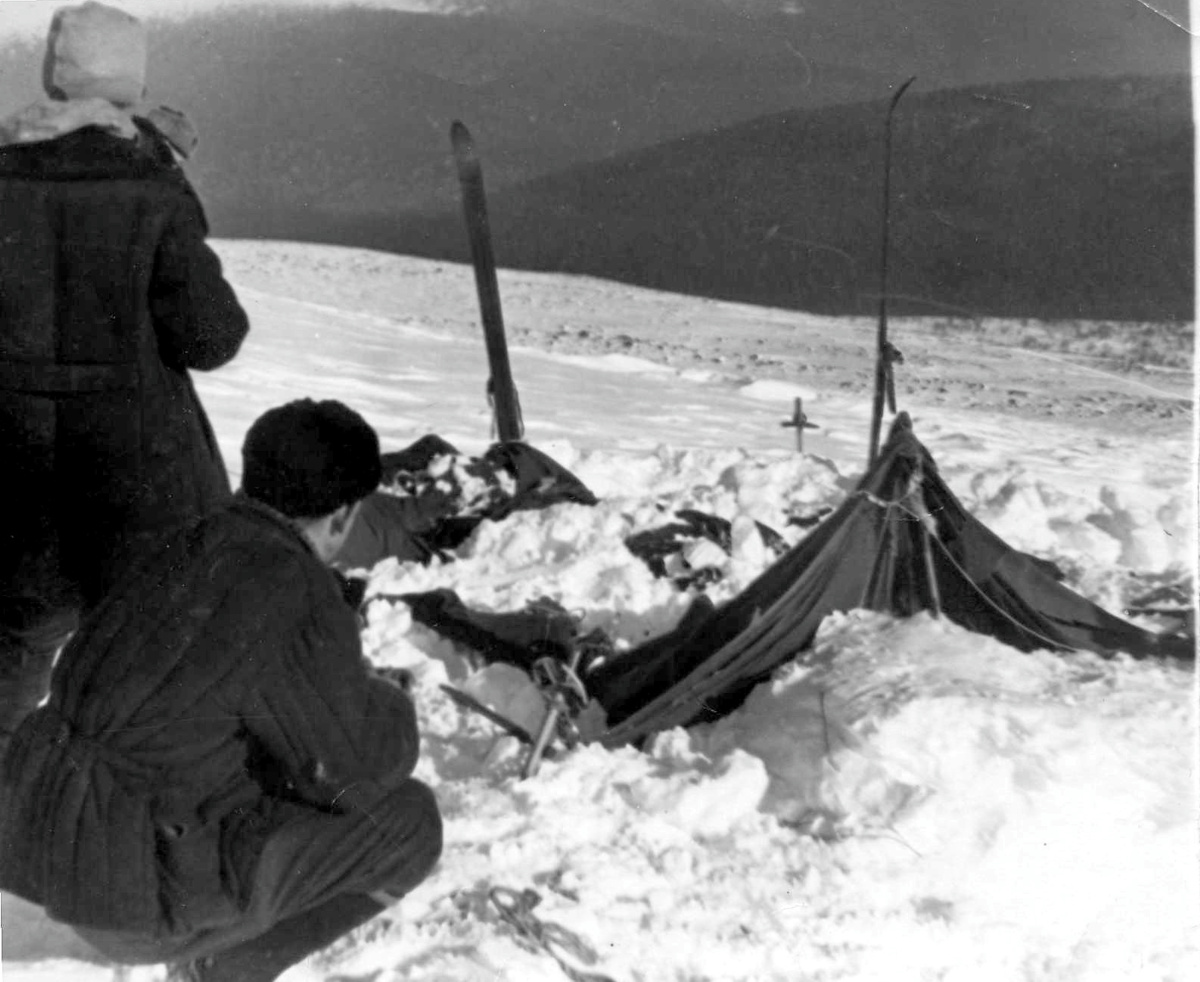
This is how searchers found the Dyatlov group's tent
There were no footprints in the immediate vicinity of the tent. Approximately 15-20 meters in the direction where the bodies were later discovered, footprints of a person walking away from the tent were visible in the snow. Moreover, it was clear that the footprints were made by a person barefoot or wearing felt boots. The footprints either protruded above the surrounding snow surface, or the snow around the footprints had been blown away by the wind.
A sheet hung in the tent; it was torn, with part of it protruding.
- 2 -
By the fire, I found a dark-colored cloth belt with ribbons at the ends, 50 cm long and 10 cm wide."
(Authors: Elena further writes: "The Mansi found scattered money, and he found a belt." And here is how Slobtsov described the finds to the investigator during questioning: "I saw the Mansi Bahtiyarov find 8 rubles in 5- and 3-ruble bills rolled up in the snow, and without me, they found a 5-kopek coin there too... Under this cedar, I found a dark-colored cloth belt with lanyards at the ends. I didn't know who this item belonged to. This item is about 80 cm long and about 10 cm wide. It looks like a belt or strap, which the Mansi use to pull loads, but this item is not suitable for use as a strap, as it is not durable."
In 2014 investigator Evgeniy Okishev told us that burnt matches were also scattered there. Clearly, something was happening on the site near the cedar. Unknown to us at this time.)
What the guys were like
The searcher, Dyatlov's friend Pyotr Ivanovich Bartolomey, is noted in Elena Koskina's notebook as a very cautious person. She writes: "He talked mostly about the guys. He worked with the climbing group at the very end. Investigator Ivanov worked with them, searching for everything for a long time, interrogating them, but one day a helicopter came for him and he disappeared, promising to return. But he never returned."
The following are the notes from Pyotr Ivanovich:
"Dyatlov. A very unique person, an excellent comrade, but a very poor leader, who didn't consult with the group at all. During a hike in Altai, Dyatlov spent the night alone in the forest a kilometer away from the group.
Kolmogorova was a very strong character, a striking woman for those times, tall, and a leader in pairs. She was well-known, very active and proactive; no event was complete without her.
Krivonischenko had a very resonant voice.
Slobodin is a very discreet but reliable person, a favorite of the group. Cheerful, humorous, kind.
Dubinina. A year before her death, she went to the Eastern Sayan Mountains with Bartolomey. She was simply forced into this group. There, 80 km from home, her leg was pierced by buckshot while shooting at squirrels. They carried her in the rain. She was constantly wet, but she behaved very courageously. The guys felt a sense of duty to her and helped her. Lyuda was remembered for her firmness and willpower.
Thibeaux-Brignolle. A very intelligent, tactful person, well versed in physics. He learned to think like an adult, looked more mature than his peers, and saw the world deeply."
Only panic could have driven them out of the tent.
Elena spoke with search participant Vadim Dmitrievich Brusnitsyn in March 1999:
"They were supposed fligh us to Otorten, but due to bad weather, the pilots made a mistake and dropped us on height (880).
(Authors: the very same pass, now called Dyatlov Pass).
We decided to descend into the forest, into the Auspiya River valley. Overnight stay. The next day they crossed the ski trail: (Sharavin, Slobtsov, guide Ivan Pashin). What a coincidence – they weren't even on Otorten (news came that the Dyatlov group hadn't been on Otorten, – Author)!
The cedar branches, 7-8 cm thick, were broken. Brusnitsyn says he couldn't have broken them; only Doroshenko could. He was the biggest and strongest. Doroshenko had a Finnish knife; he used it to cut down fir trees. The pork loin was cut up and distributed for the night. It was ready for dinner. Everything in the tent was thoroughly prepared for the night. There was nothing out of the ordinary. Everything was as all hikers prepare for the night, nothing out of ordinary. No anarchy!
The searchers ate all the food from the labaz and drank the alcohol.
(Authors: What if the Dyatlov group died of food poisoning? Why weren't these foods sent for analysis? Who so recklessly allowed the hikers' supplies to be eaten?)
There are no signs of what happened next. There's no way to get them out of the warm tent with their belongings and blankets. What could cause this? Only panic. What caused the panic? Light? It doesn't last long. It won't frighten them. Same applies to a sound — why run from it?
They said, don't spread the word too much.
(Authors: Apparently, the authorities warned the students about this.)
- 3 -
"How did they start a fire in this wind?"
Meeting with one of the first searchers, Mihail Petrovich Sharavin:
"There were no signs of a rocket explosion nearby, no damage to the forest, no burn marks, no signs of any foreign presence.
We climbed up to the remnant, saw a cedar below, and descended to it—Doroshenko's body was there. We dropped our backpacks and ran up in horror—a helicopter with searchers and dogs was landing on the pass.
The ground near the cedar was bare, with about 80 mm of snow, since the spot was elevated, the fire was small. This could be considered more of an attempt to start a fire. There were few embers or coals—how could such a fire even burn in such a wind-blown environment? There were no signs of birch trees; they were lighting the fire with thin, dry branches from the cedar trees below. The branches were so broken off they were impossible to reach.
Krivonischenko lay next to Doroshenko.
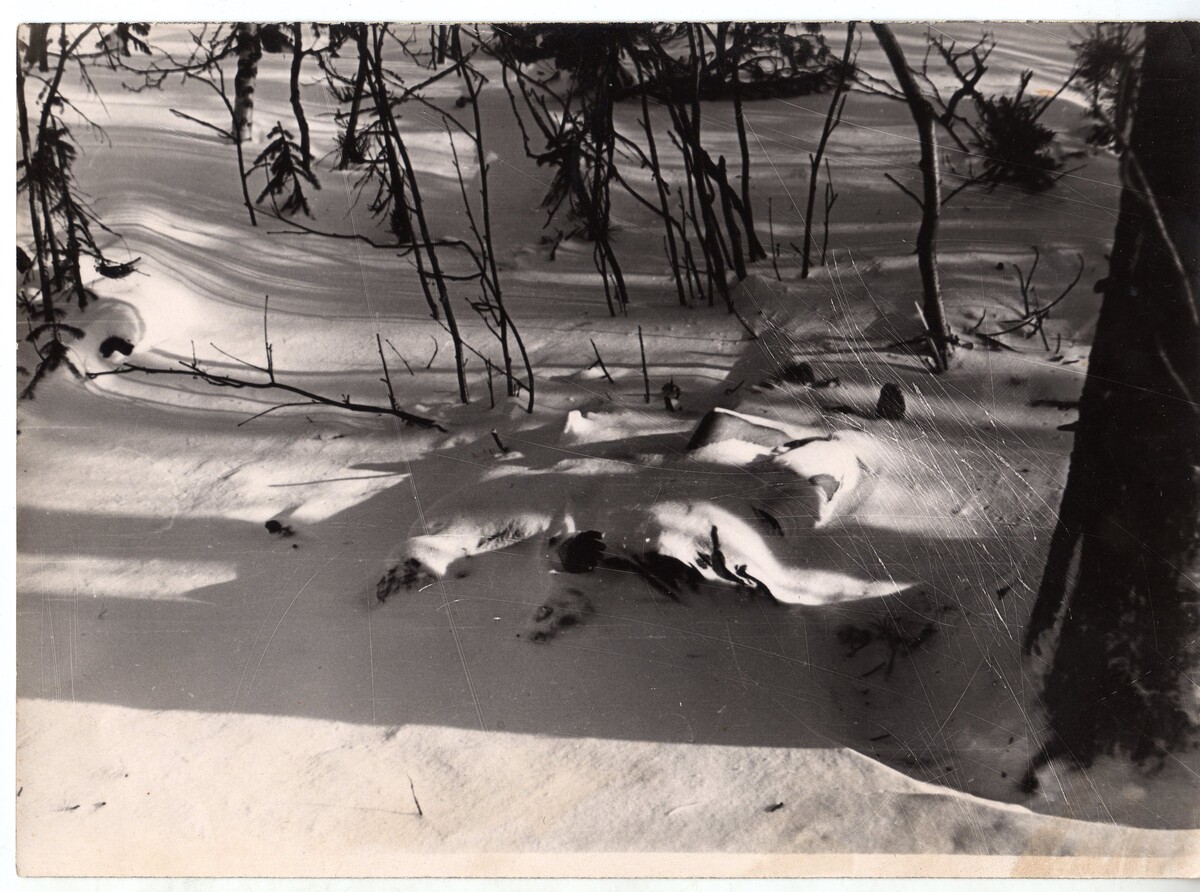
This is how searchers found the bodies of Yuri Krivonischenko and Yuri Doroshenko under a cedar tree
It was clear that people had placed them there, their arms by their sides. We saw them, but we couldn't move them. Why? They came to choose a place for a camp, and there were corpses there!
(Authors: It's a bit strange to read about a wind-blown dam. We've been to the cedar several times, both summer and winter. While there really is a wind-blown dam on the slope—400–500 meters above the cedar—and quite a powerful one, it was completely calm near the cedar.)
"Prisoners who had run around"
Searcher Vladimir Aleksandrovich Lebedev:
"Lebedev was supposed to lead a group along the Denezhkin Kamen - Konzhak route. There weren't enough skis or a tent, so they were expected. The deadline expired, and the girls were removed from the group. The remaining group formed a search party. This was Boris Slobtsov's first group. They arrived at the pass by helicopter in two groups. The first one landed, then the helicopter took off, saw people waving on the slope—it descended, thinking they were the missing group, but they were actually escaped prisoners who had been running around.
(Authors: Let's dwell on this point in more detail. About 20 years ago, Vladimir Korotaev, an investigator for the Ivdel prosecutor's office in 1959, categorically stated in an interview that there were no prisoner escapes from the Ivdellag in January-February 1959. However, Galina Sazonova, a researcher of the tragedy, discovered information about escapes in the State Archives of the Russian Federation, one of which occurred on February 19.
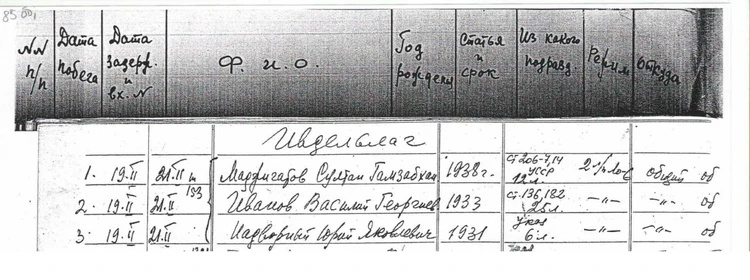
Copy of a document from the Ivdellag archive.
Three prisoners escaped due to poor convoy organization. They were returned to the camp on February 21.
When did searcher Lebedev arrive at the pass? From his interrogation in The criminal case states February 21st. And it all seems to fit. On February 21st, the first search teams were transported from Ivdel to the site. Helicopters took off, heading for Ivdel, and spotted prisoners on one of the bare slopes. They were picked up and transferred to the penal colony.
However, Lebedev was mistaken. He and Boris Slobtsov's group only arrived at the pass on February 23rd. This was stated during interrogation by both Slobtsov himself and search leader Evgeniy Maslennikov. The same date is mentioned in the report of the Moscow climbers who arrived in the Northern Urals on the orders of the CPSU Central Committee.
So, the helicopter pilots picked up other prisoners in the mountains. Who were they? Where did they escape from and when? Why is this escape not documented? Were the escapees witnesses to the death of Dyatlov's group? Many questions, no answers.
- 4 -
Ball lightning or UFO
In 1999, Elena Koskina traveled to Kazakhstan, to the city of Kostanay, where investigator Lev Ivanov lived. Lev Nikitich had been dead for two years, but Elena spoke with his daughters.
"Trip to Kostanay.
I called the Ivanovs. His wife, Elena (or rather Leontina) Grigoryevna, answered. We got to talking—she has relatives in Yekaterinburg, and her mother is buried in the Mikhailovskoye Cemetery. What a coincidence! There's an investigator in the regional prosecutor's office in Yekaterinburg who knows Lev Nikitich from work. She can tell a lot.
Ivanov's wife's mother worked at the same factory as Lyuda Dubinina's mother.
Daughters: Tatyana, Aleksandra.
To the point: he told me about his business trip to Ivdel a couple of times. The fireballs—ball lightning or UFOs. The Mansi said they warned hikers not to go to that mountain because devilish fireballs fly there, but they disobeyed.
The book was a gift from Evgeniy Polikarpovich Maslennikov (head of the hikers search, — Author) dated September 7, 1959:
"To the esteemed Lev Nikitich Ivanov, in memory of the hikers he had to meet against his will. With wishes for you to follow the routes in this small book. From the authors Rubel and Maslennikov." (Raisa Borisovna Rubel, Associate Professor of the Department of Physical Geography. Master of Sports in Tourism, — Author).
Zinaida Kivokurtseva, Lev Ivanov's colleague in the legal profession:
"A very decent person, he never refused business trips, helped almost everyone who turned to him for assistance. He never shared his impressions of his work. He only spoke about the Dyatlov group a couple of times: UFOs, absolutely no signs of any strangers."
"What if I turn out to be guilty?"
Searcher Boris Leonidovich Suvorov arrived to search as part of Vladimir Askinadzi's group on April 27th. That day, Boris turned 18.
Boris told Elena: "We got up early in the morning, Kurikov (Mansi Stepan Kurikov, — Author) announced the course of action, that is, he led the geographical plan. Colonel Ortyukov led the expedition, and specifically Askinadzi's students. We searched with probes. A probe is a three-meter stick with a hook at the end; You poke, twist, and pull out. We didn't get into the stream (the place where the four hikers' bodies were found – Author) right away, but followed clues. These included melted objects, broken branches, and the dog Alma was very helpful. A ravine ran down the slope, with a stream running along the bottom.
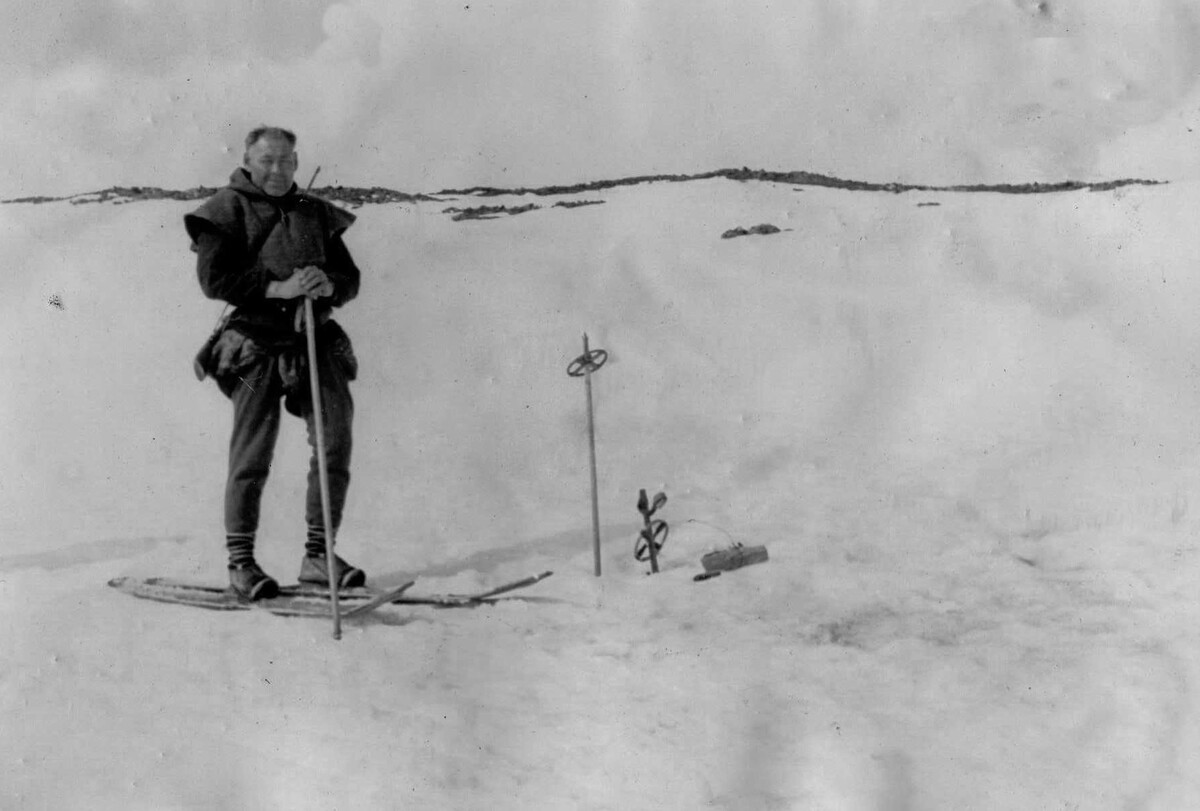
Mansi Stepan Kurikov was an active participant in the search for missing hikers
They dug a platform 3 meters deep—they were very surprised, as it was empty. They began searching around. Near the platform, there was a spot with signs of human activity. So they began probing the area.
Then they dug up the bodies, pulled them out, placed them on skis and stretchers made of tents and branches, and dragged them up the pass to the helicopter. The helicopter pilots categorically refused to load the bodies, meaning they refused to take non-transportable cargo on board. Colonel Ortyukov (the search leader, — Author) was nervous, pulled out his pistol, and started waving it around.
- 5 -
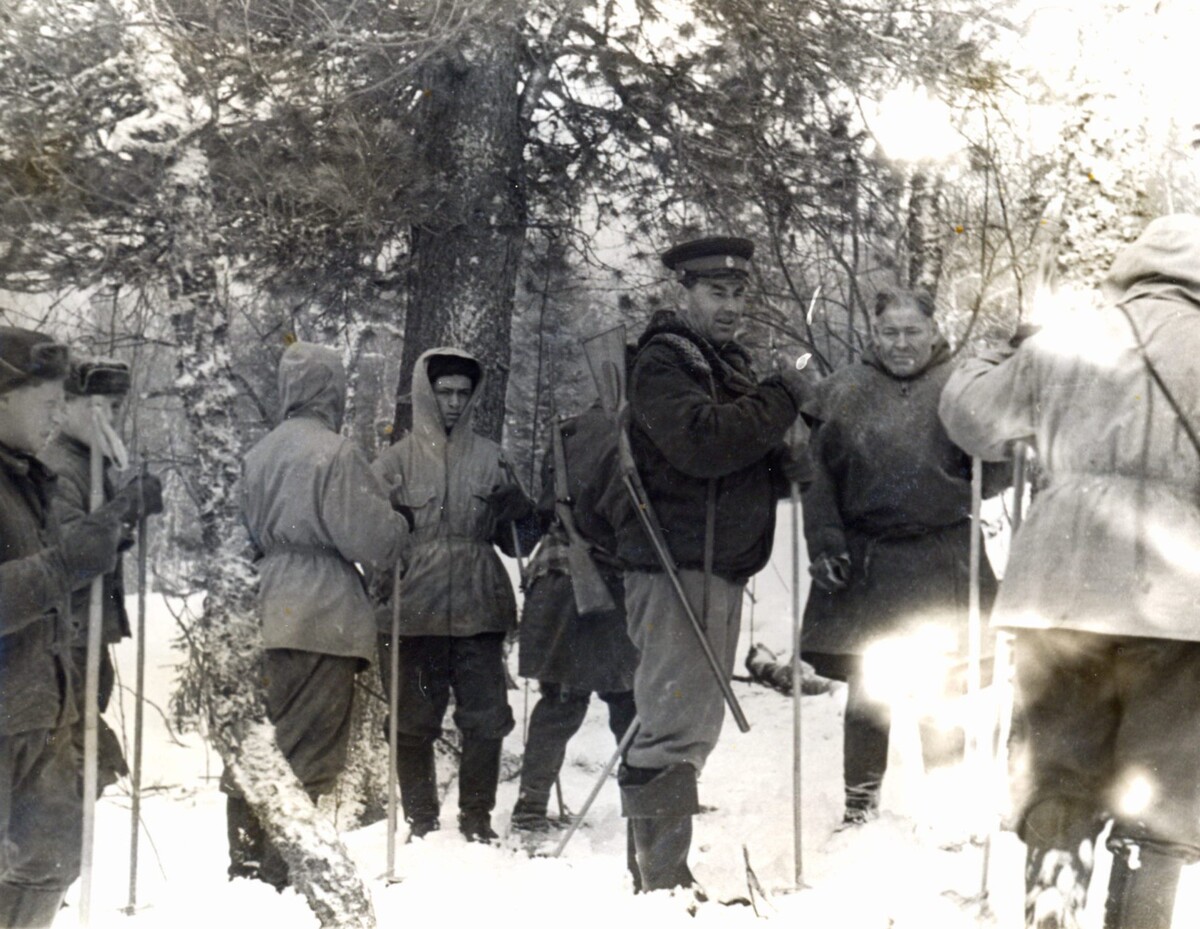
Colonel Ortyukov (in a cap) during searches at the pass
Vozrozhdenniy (Boris Vozrozhdenniy, the forensic expert who autopsied the bodies of the deceased, - Ed.) appeared and said something like this: "If I give you a conclusion that they are not transportable, you can bury them here. But there will be a showdown, you never know - I'll be found guilty, so I'll give the conclusion that they are transportable." Colonel Ortyukov was persuaded not to shoot.
They discussed among themselves why the tent was on the slope.
Thibeaux-Brignolle fell on one slope and injured his head.
(Authors: Elena writes underneath: "It's astonishing, there was no examination yet, but they already knew about the fracture." This is also surprising for us. How could the searchers have known about Kolya Thibeaux-Brignolle's head injury at the time?)
Deeply convinced: they saw no traces of strangers.
Vozrozhdenniy's words: "If they hadn't been Phystech students, they would still be alive" (most of the expedition participants studied at the radio engineering, construction, physics and engineering, and mechanical engineering faculties of the Ural Polytechnic University or had already graduated from them, — Ed.). Comment from Vladimir Askinadzi, who was Phystech student himself: "Lev Ivanov believed the fireball theory until the end of his days. This was passed on to Vozrozhdenniy. The actual atomic bomb explosions and their consequences were hammered into the minds of the Phystech students in their curricula. The explosions over Hiroshima and Nagasaki in 1945 were the most common examples. According to Ivanov, the Dyatlov group (the two who were outside the tent) mistook the fireballs for an atomic explosion and caused a panic. The Phystech students knew the consequences of these explosions better than anyone else, and by the time they emerged from the tent, the fireballs had already flown over the horizon. But the aftereffects of the panicked screams continued to trigger panic, and the group rushed down the slope, away from what they thought was the radiation."
When they were loaded onto the helicopters "Bodies, no other action was taken. They loaded up and left. No inquiries, no forensic examinations. Only, apparently, the Mansi could recreate the scene (apparently, a search for bodies, - Author). They planned a trip for the following year, but they weren't allowed in—the area was closed."
A Radio Operator's Memories
Egor Semenovich Nevolin
Entry from March 19, 1999:
"Ivanov said then—we can't take photographs (referring to the discovery of the bodies of the last four, - Author). They pulled them out.
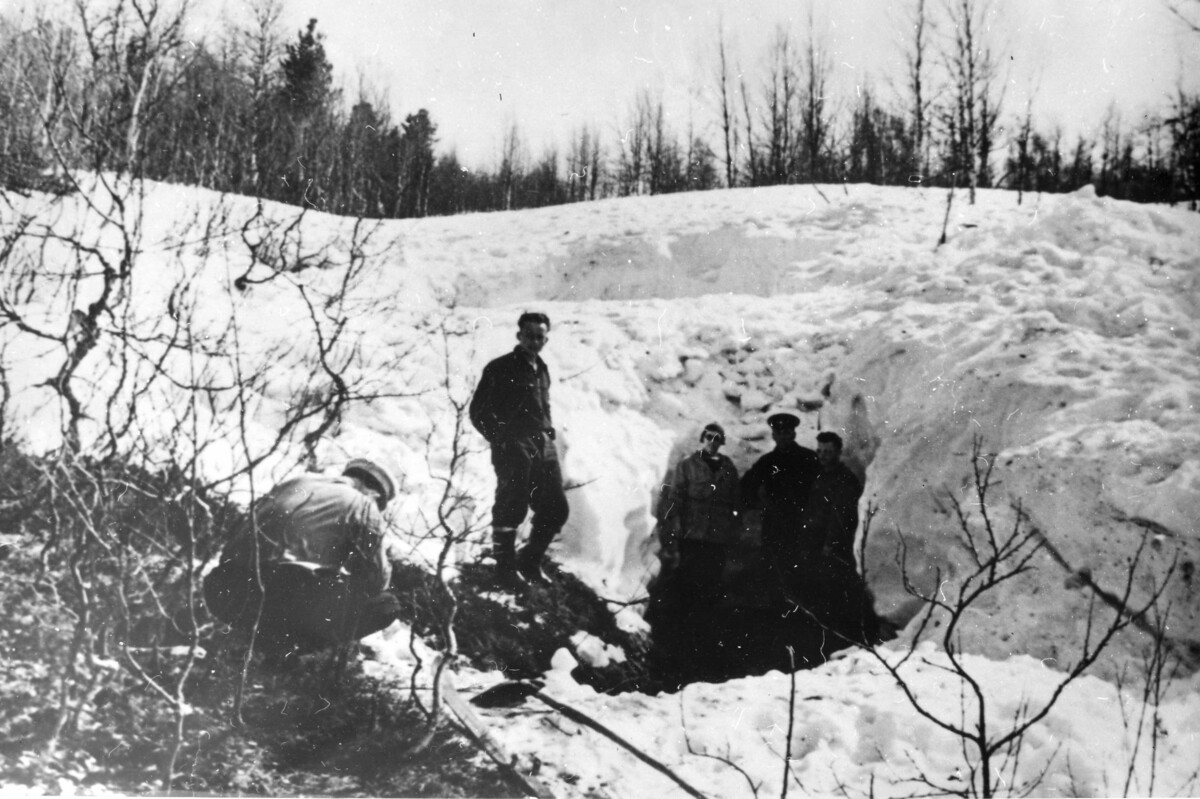
Searchers at the location of the bodies of the last four in the ravine
That day, Vozrozhdenniy arrived, and the bodies were loaded. It was May 6th. We gathered up the things, carried them to the helipad, and loaded them. Ortyukov, the Kurikovs, and I stayed until May 13th. On the 13th, a helicopter arrived, loaded everything, and the helicopter pilots wanted some venison. They flew to the Sambindalovs' yurt, exchanged it for alcohol (fuel for heating the helicopters), and flew away. That was it. That was the end of the search."
(Authors: The Sambindalovs' Mansi camp is about 70 kilometers from Dyatlov Pass. That's how easy it was for helicopter pilots to go for meat in those days.)
Related articles
 Elena Koskina's notes


