

10-01-2026
Regional Committee to the Parents of Dyatlov Group Hikers: "The Guilty Have Been Punished"
Notes and recollections of Elena Koskina
January 10, 2026. All rights reserved Komsomolskaya Pravda. Authors Nikolay Varsegov and Natalya Varsegova

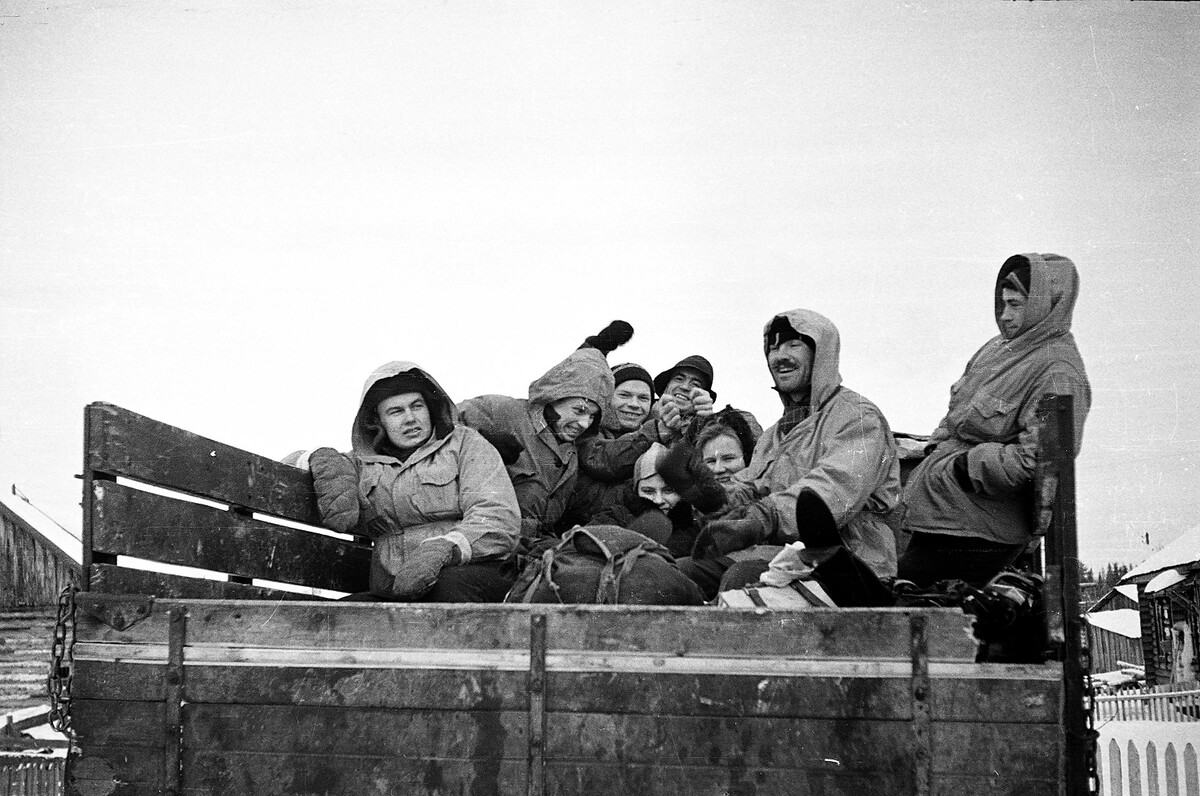
The beginning. The Dyatlov group, in full force, travels from Vizhay to District 41
We are confident this publication will inspire deep reflection among those interested in the topic. A month ago, Alexey Koskin, head of the Dyatlov Memorial Foundation, gave us a notebook belonging to his ex-wife, Elena. In it, she chronicled her investigation into the hikers' deaths. From 1989 to 1999, Elena communicated with searchers and recorded their recollections of the tragic events of the winter of 1959.
"Died by the Force of Nature"
As a reminder, nine hikers disappeared in the Northern Ural Mountains at that time: a fifth-year student at the Ural Polytechnic Institute (UPI) and the group's leader, Igor Dyatlov, as well as Yuri Krivonischenko, Yuri Doroshenko, Rustem Slobodin, Zinaida Kolmogorova, Lyudmila Dubinina, Aleksander Kolevatov, Nikolay Thibeaux-Brignolle, and Semyon Zolotaryov. Before their deaths, the investigation would establish, they panicked and ran out of their tent, half-dressed and barefoot, down the slope, lit a fire in a windless spot… and perished.
The frozen and mangled bodies of all nine were found within a kilometer and a half of the tent. The last frame of the tourists' film captured strange glows. The investigation never determined the cause of death, explaining the tragedy with the vague explanation that the tourists died from "an act of God they were unable to overcome."
Elena and Alexey Koskin became fascinated with this topic in 1988. It was then that they managed to obtain, one might say, the first recollections of the relatives of the deceased tourists and those involved in the search. Today, these stories are especially valuable, as over the years, eyewitness accounts have become significantly distorted—that's just how our memory works.
We are publishing the entries virtually unedited and ask that you disregard any minor typographical errors. Elena clearly did not intend for this manuscript to be included in the country's history.
"Our children are not criminals"

One of the last photos of Rustem Slobodin on the fateful expedition
- 2 -
May 9, 1989
Memories of Rustem Slobodin's mother, 88-year-old Nadezhda Fyodorovna:
Rustem graduated from the mechanical engineering department with honors and was already working. When the group's term ended, the search began. Then all the parents were gathered at the regional party committee and informed that their children would be buried in Ivdel (a city in the Sverdlovsk region - Ed.). The Dyatlovs were already preparing to leave; they were brought back from Serov. But Slobodins and Kolmogorovs flatly refused: "Our children are not criminals; they were on vacation; they will be buried in Sverdlovsk." The bodies were brought in. The children were already dressed in white shirts and blue suits. The graves had already been dug. The coffins stood in the Physics and Technology Department dormitory. Exposed areas of skin were chocolate-colored; beneath the clothing, the skin was normal.
(Authors: As forensic experts have repeatedly stated, with severe frostbite, the skin turns black due to cell death.)
Attempts to restore everything at the regional party committee were unsuccessful. The parents were told: "Whoever needs to be punished has been punished."
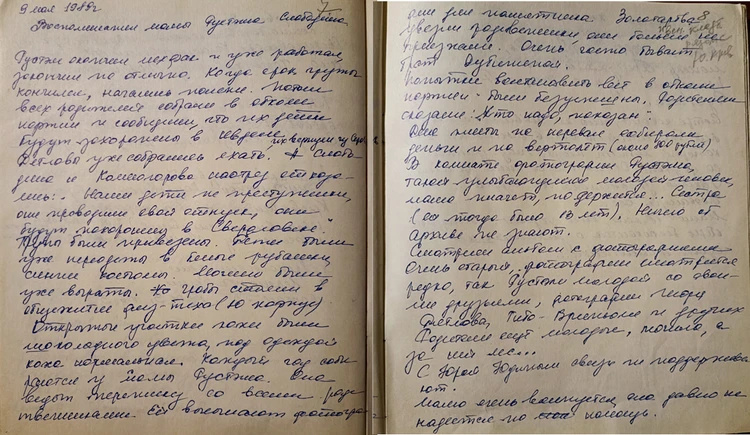
Pages from a notebook containing notes of recollections from Rustem Slobodin's mother
Let us repeat, above was the story of Rustem Slobodin’s mother. Next Elena Koskina's notes:
Every year they gather at Rustem's mother's. She corresponds with all the relatives. Dubinina's brother comes very often. They send her photos for the monument. Zolotaryov's relatives took him away; they never came back.
(Authors: Well, here's another riddle to add to the long list of riddles about Zolotaryov. In fact, Semyon Zolotaryov is buried in Yekaterinburg. Only his mother attended the funeral.)
They collected money for a plaque at the pass and for a helicopter (about 800 rubles).
(Authors: The very same memorial plaque on the outlier at the pass itself, erected by friends of the Dyatlov group in 1963.)
In the room are photographs of Rustem – a smiling young man, his mother crying, but holding on... We looked at a photo album. A very old one. Rustem is in it with his friends. Photos of Igor Dyatlov, Thibault-Brignolle, and others.
We haven't maintained contact with Yuri Yudin (the tenth surviving member of the expedition, who withdrew from the route due to illness – Author). His mother is very worried; she has long since given up hope of help.
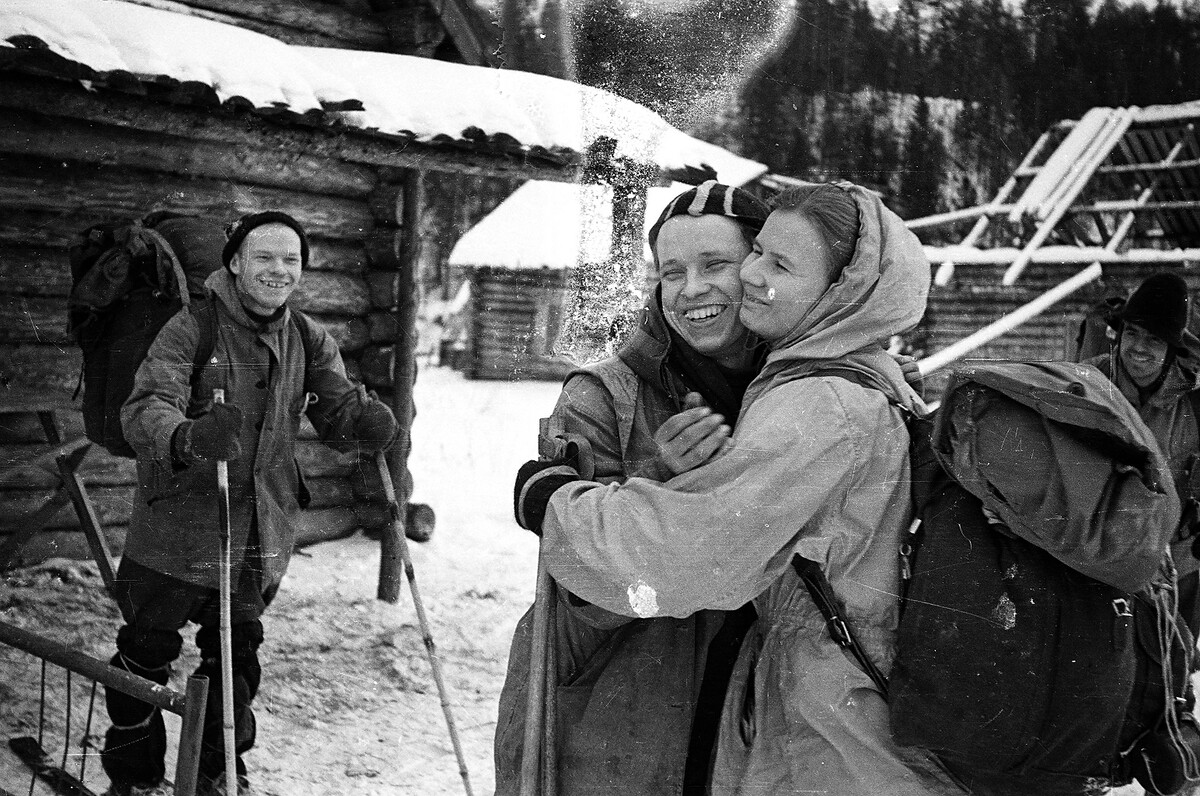
Yuri Yudin left the route due to illness and survived
She said someone sent 20 rubles to paint the grave. In the fall of 1988, they gathered and painted the grave. Almost everyone came.
His sister says that, according to the rescuers, there was some kind of explosion, a fireball flying low over the ground. A missile veered off course... That's probably all. My mother is 88 years old and can barely walk. She's very worried about the future of the monument."
- 3 -
"He said that this was his last trek."
Elena Koskina recalls a phone conversation with Aleksander Kolevatov's sister, Rimma. "Sasha, don't go. We bought you a suit, but don't go. You have your thesis to write," Rimma pleaded with Aleksander before the trip.
Further from Elena Koskina's notes:
Sasha replied that this was his last campaign and that was it – no more. He'd go and start writing his thesis. He always returned satisfied from the company of these guys. He was the youngest son in the family and named after his uncle, who fought for the Red Army with Sasha's father. One day, they were captured by White Guards and lined up in the snow, stripped to their underwear. Every fifth person was shot. My uncle was among them.
Aunt Marusya, 87, told me about Yuri (Doroshenko, - Author) – his illness in his youth, but his fortitude. Doroshenko and Kolmogorova were supposed to get married after the expedition.
Zolotaryov, according to her, was imprisoned in Vizhay, has a wife and children, was taken to Kourovka, where he was buried.
(Authors: a very strange statement, the origin of which is unclear. But it once again demonstrates that no one really knew anything about Semyon, and his appearance in the Dyatlov group raised questions for many).
A group from the Pedagogical Institute (bio-geo) saw a fireball in early February on Otorten (they were on Chistop).
(Authors: apparently, this refers to early February 1959).
The parents demanded that Kurochkin, Ufimtsev, Gordo.
(Authors: Vil Fedorovich Kurochkin - Chairman of the City Committee for Physical Culture and Sports.
Lev Semenovich Gordo - Chairman of the Board of the Sports Club.
Valerian Mikhailovich Ufimtsev - Instructor of the City Committee for Physical Culture and Sports.
These officials were punished, but along party lines. Here is how investigator Lev Ivanov wrote about it in the decision to terminate the criminal case: "For shortcomings in the organization of tourism work and weak control, the Bureau of the Sverdlovsk State Committee of the Communist Party of the Soviet Union punished along party lines: Director of the Ural Polytechnic Institute Siunov, Secretary of the Party Bureau Zaostrovskiy, Chairman of the UPI Trade Union Committee Slobodin, Chairman of the City Union of Voluntary Sports Societies Kurochkin, and Union Inspector Ufimtsev. Chairman of the Board "The Gordo Institute's sports club has been dismissed from its duties. ... There is no connection between the actions of the above-mentioned individuals, who allowed shortcomings in the organization of sports activities, and the death of the hiker's group."
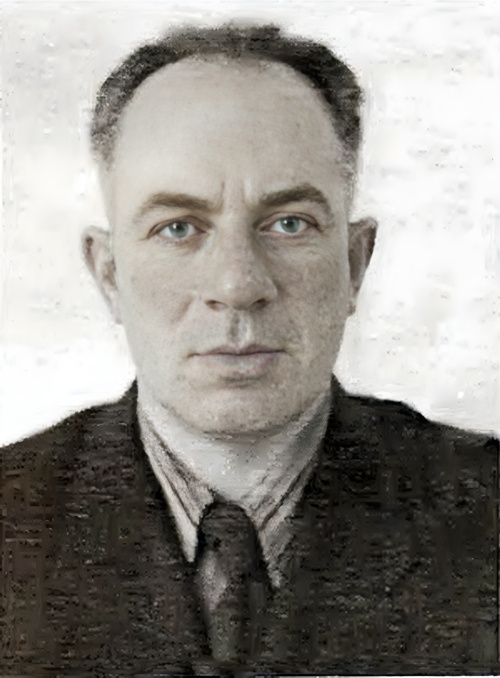
Lev Gordo was indirectly blamed for the deaths of the hiskers
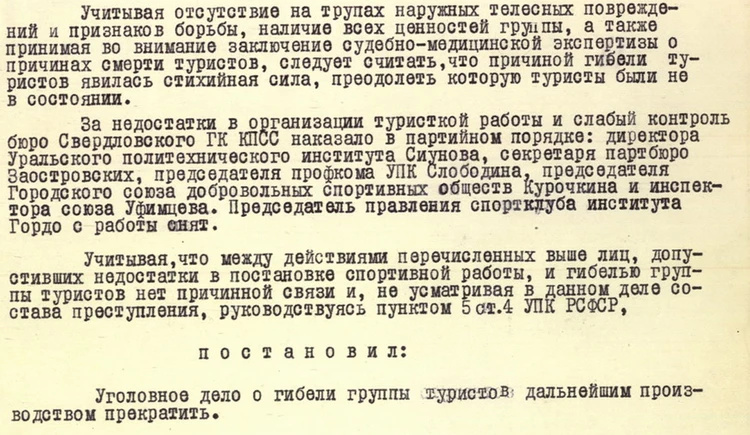
Quote from the decision to terminate the criminal case
A year later, all penalties against those punished were lifted, and Gordo was reinstated. However, the parents were never told the true cause of death.
- 4 -
"These Strange Funerals"
Valentin Gerasimovich Yakimenko, a participant in the search for the Dyatlov group:
"When the first five were buried, all the funeral notices were torn off the walls. People ran into the classrooms and announced the time and place of the funeral.
The funeral was held in huge numbers. They wanted to carry the coffins from the radio department dormitory building and past the other UPI dormitories, but police were stationed at every intersection. As it later turned out, the police had been alerted, and plainclothes men were patrolling the courtyards.
(Authors: further part of the page is torn off, the meaning of the writing has to be guessed from incomplete sentences)
The procession had to turn left…. There was a hole in the fence, to which... and again the police.
... Kolmogorova was very indignant, suggesting a stele.
Enormous funds were allocated for the monument, but they weren't used on time, and they were wasted. They couldn't build the stele either. They erected a regular monument.
About what happened. They envisioned a sound and light effect. There was no talk of radiation. People weren't thinking about it. There were an awful lot of theories, starting with this one (apparently, a missile attack – Author) and ending with the idea that the guys had a fight over girls."
(Authors: A very curious point. Most of the searchers we spoke with in the 2010s claimed that in 1959 they only discussed the missile theory. It was, they said, the most credible and plausible. From Yakimenko's memoirs, we see that they even considered a fight.)
The following are entries from Elena's perspective:
"Someone – Yakimenko or Slobtsov (also a searcher) – said that a drunken military rescuer in a restaurant let it slip that his comrade had found Kolevatov's notebook, which listed the cause of the explosion and death. This notebook was passed on to the authorities. Where she is, and whether she really existed, is unknown.
Attempts were made to find out something. But! Yarovoy (Yuri Yarovoy, a journalist whom investigator Ivanov took as a witness in the search, - Author) and Maslennikov (Yevgeny Polikarpovich, head of the search headquarters, - Author) went to see the investigator. They were given cameras, film, and some other belongings. They signed non-disclosure agreements."
(Authors: The investigation is silent on whether Sasha Kolevatov's notebook was actually found. But we know for sure that not all of the hikers' personal belongings were included in the crime scene report. One example: Yura Krivonischenko is known to have always (!) jotted down route sketches, meaning he sketched out a map of the area, landmarks, and so on while on the trail. This hike was hardly an exception to the rule, but his notebook with the sketches is nowhere to be found. Therefore, it's possible Kolevatov's notebook was also there and disappeared for reasons still unknown.)
Yuri Efimovich Yudin and Elena Koskina
Anatoliy Gushchin "The Price of State Secrets - Nine Lives?"
Related articles
 Elena Koskina's notes part 2


