

January 2026 Expedition Plan
24-01-2026

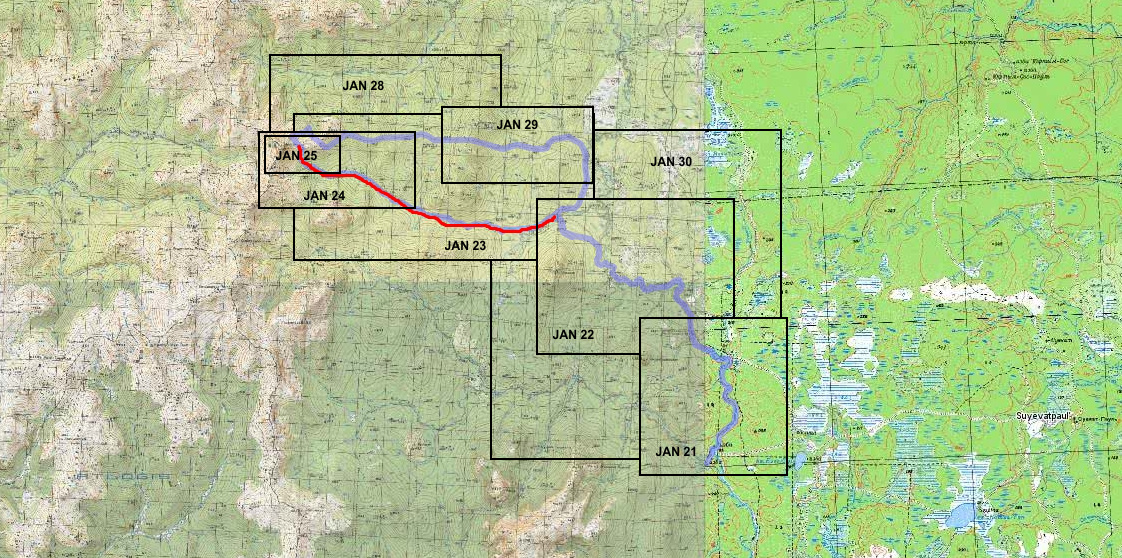
Here's our circular route. The blue line is where the snowmobiles drive. The red line is the trail on Auspiya.
Day 1. January 20.
Meeting in Yekaterinburg and boarding the evening train to Ivdel.
Day 2. January 21.
Arrive in Ivdel at 3:00 AM and transfer to a GAZ-66. Arrive in Ushma in the morning.
Also on the train, fill your thermoses with boiling water. (This may not be possible in Ushma.)
In Ushma, we gear up, leave provisions for one dinner and one breakfast, and discard any unnecessary items.
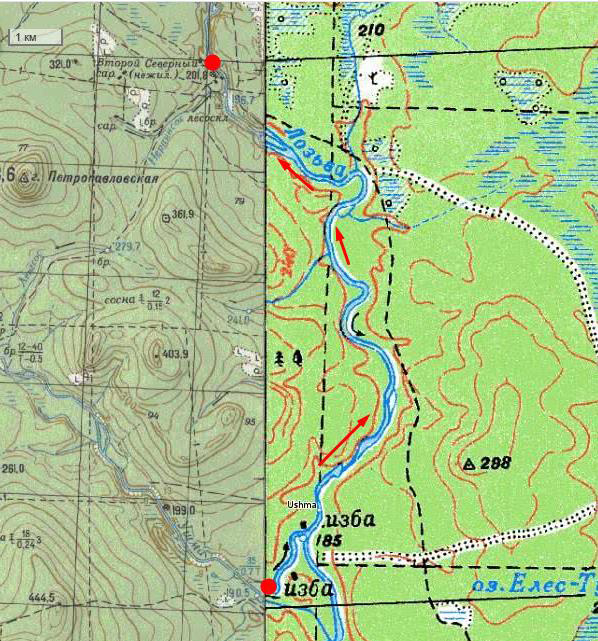
We make a 12-km hike along the Lozva River to the former settlement of 2 Severny and set up camp for the night. Since we won't be able to sleep last night, we'll spend the 12 km. Enough for the first day of hiking.
This trek is planned directly along the Lozva River, along a snowmobile trail. We'll travel in a boot with a sled. The backpack is in the sled. The skis are tied to the sled, on top of the backpack. Those who wish can ski. The sled with the backpack is hitched behind it.
If there's a snowfall overnight and not a single snowmobile passes afterward (and they often travel back and forth in that area), we'll ski. We'll take turns breaking trail. The backpacks are in the sled.
The cave "Whale's Mouth" is on the left in the photo of the Dyatlov group:
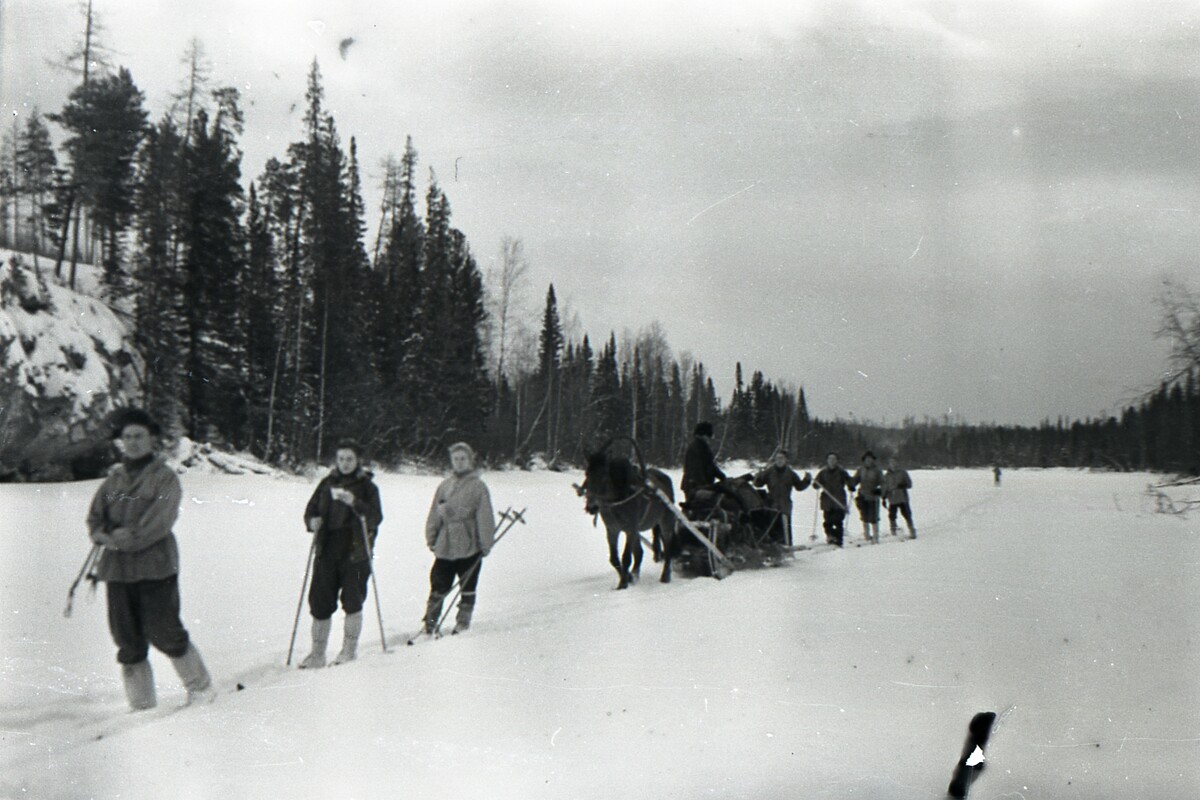
Women are prohibited from approaching the cave..
Day 3. January 22.
19 km hike to Auspiya.
First, we travel along the Lozva River. At a certain point, we leave Lozva for a snowmobile, which, skirting the sacred mountain of Hoy-Ekva, will take us to a place called the Auspiya ford. This crossing is planned along a snowmobile trail. We travel in a boot with a sled. The backpack is in the sled. Skis are tied to the sled, on top of the backpack. Those who wish can ski. The sled with the backpack is hitched behind.
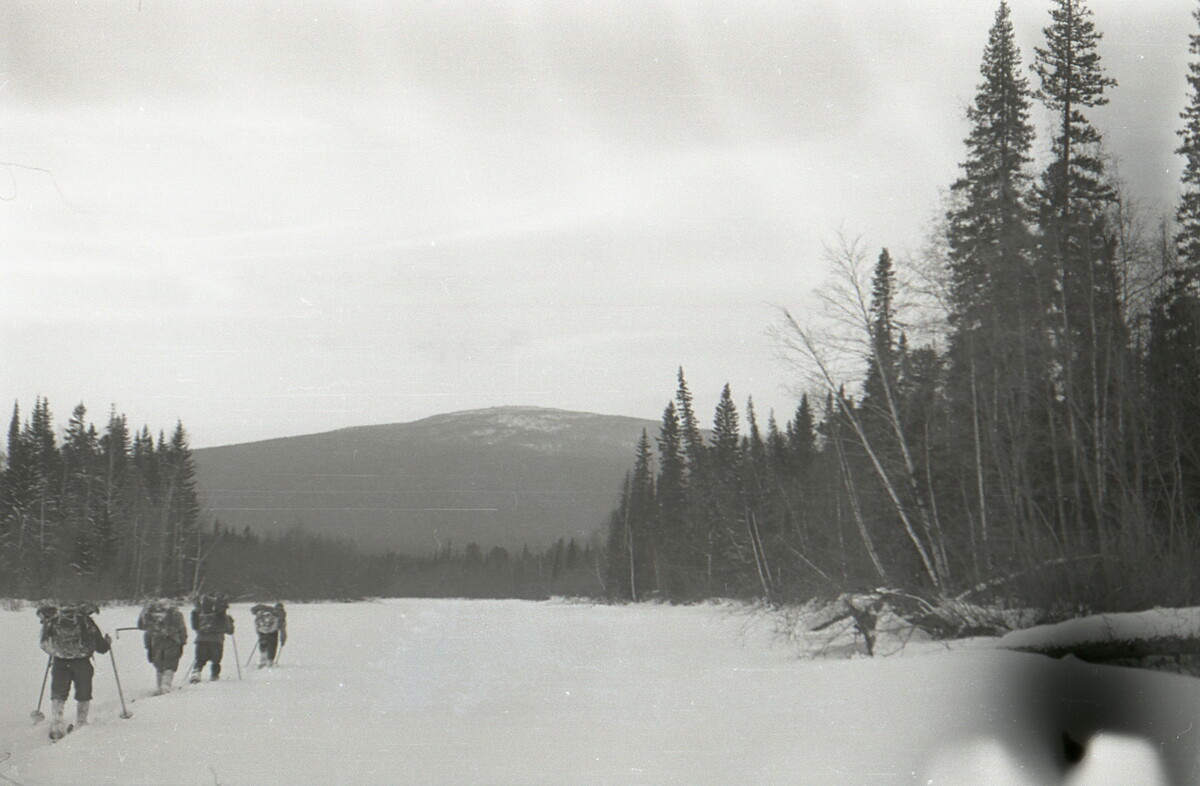
If there is a snowfall overnight and not a single snowmobile passes afterward (and they often travel back and forth in that area), we travel on skis. We take turns tracking. Backpacks are in the sleds. In the background is the sacred mountain Hoy-Ekwa (woman, do not approach):
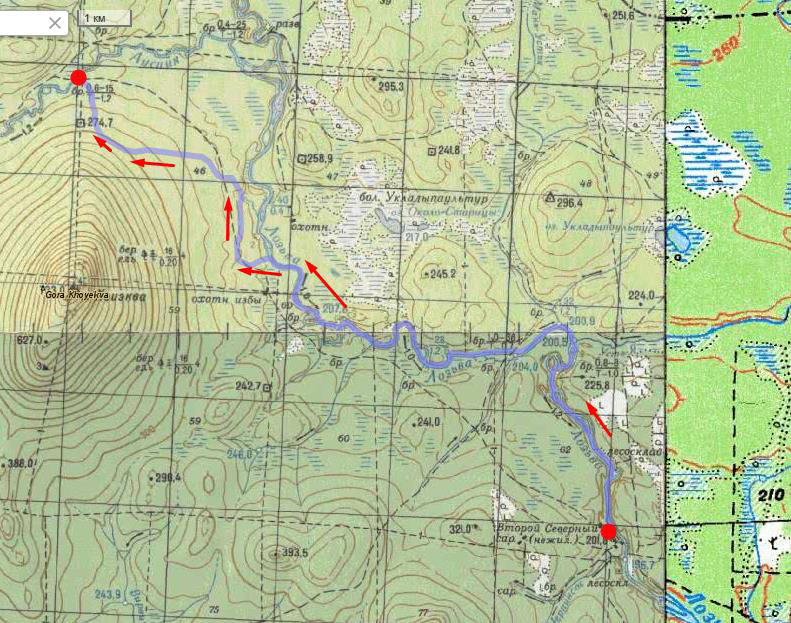
In the afternoon, the ascent is approximately 100 meters:
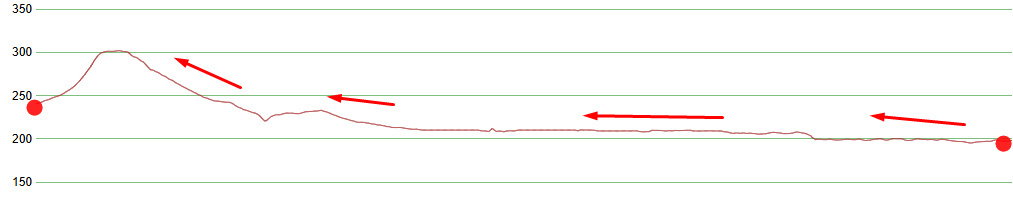
- 2 -
Day 4. January 23.
The maximum possible distance up the Auspiya, but no less than 15 km, is covered. This is a difficult section of the route. The trail follows the Dyatlov group's route. Or the Markov group's 1999 route. If that doesn't work, then the Romanenkov route.
Evening or in the morning, we assess the snow depth and choose one of the options: directly along the Auspiya River (if it's completely frozen) or along the old Mansi reindeer herding trail, which is located on the northern part of the river. In the afternoon, we'll most likely move along the river.
This trek is planned on skis in the snow, taking turns following the trail. Where the snow is deep, we strap backpacks with sleds onto our shoulders. Where the snow isn't deep, we try to drag sleds... It all depends on the amount of snowfall by January 23rd... In my opinion, this is the second most difficult day of the entire hike, after Day 5. I've never hiked this particular section in winter. Only in summer.
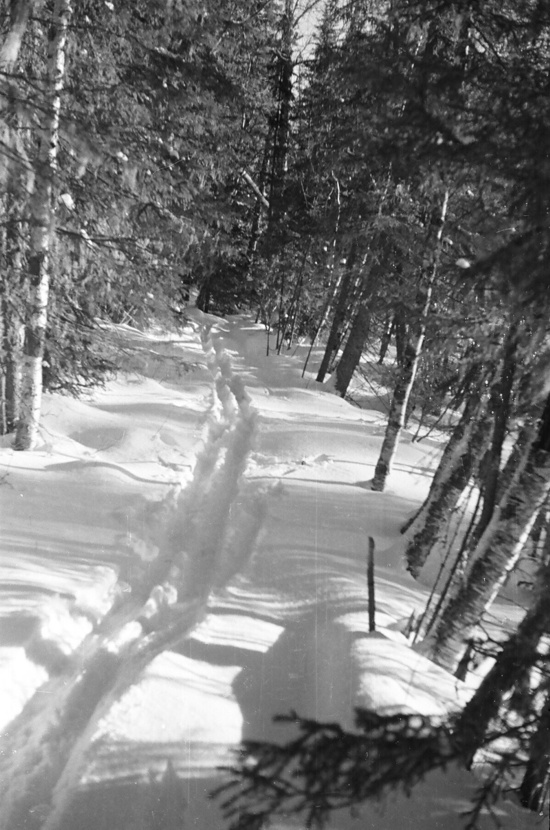
The river debris is avoided through the forest:
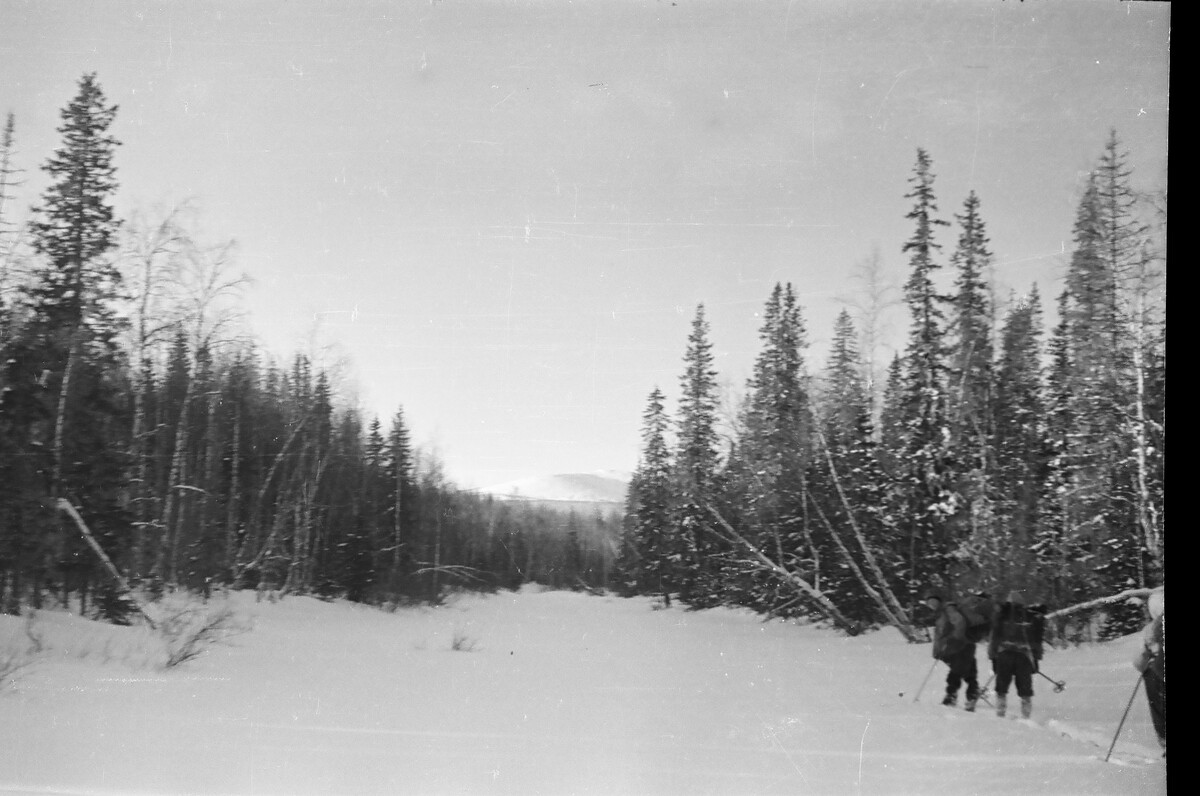
In the background of the photo of Dyatlov's group is Kholat Syakhl:
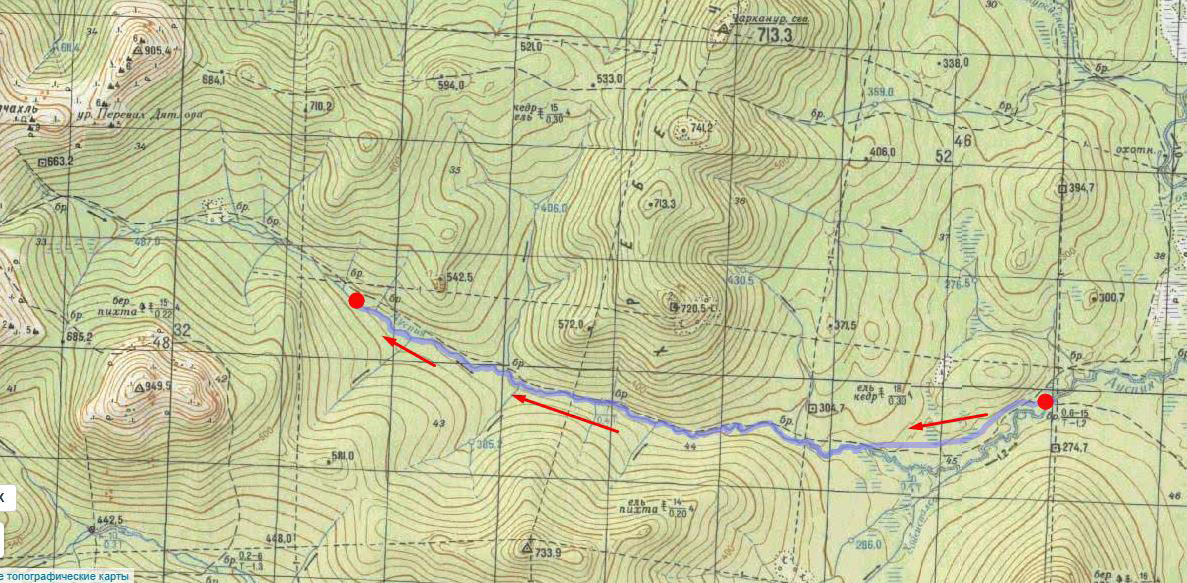
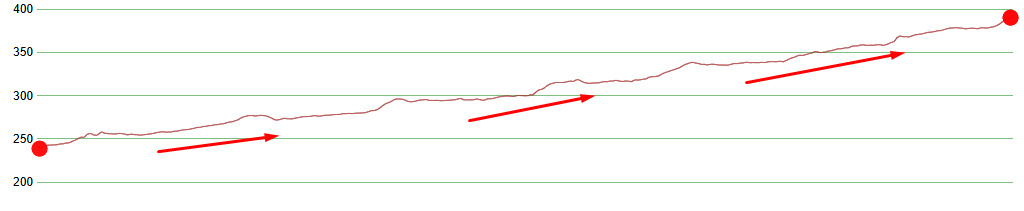
In the afternoon, the ascent is approximately 100 meters:
- 3 -
Day 5. January 24.
We'll hike the remaining distance to the presumed location of the Dyatlov group's cache, near Kuntsevich's campsite/the 1959 search camp. If we cover 15 km on Day 4, then on this fifth day we'll have approximately 7-9 km left (depending on the number of blockages). This is the most challenging terrain of the entire route, with blockages and windfalls, and a climb through deep snow.
We'll be skiing with backpacks on our backs. In my opinion, this is the most challenging day of the entire hike. The difficulty depends on the number of blockages on the river. Some groups planning to hike this route in winter have turned around this section. Leading participants, without backpacks, will have to find and choose the most logical and least difficult route through the dense forest.
I've never hiked this particular section in winter. Only in summer.
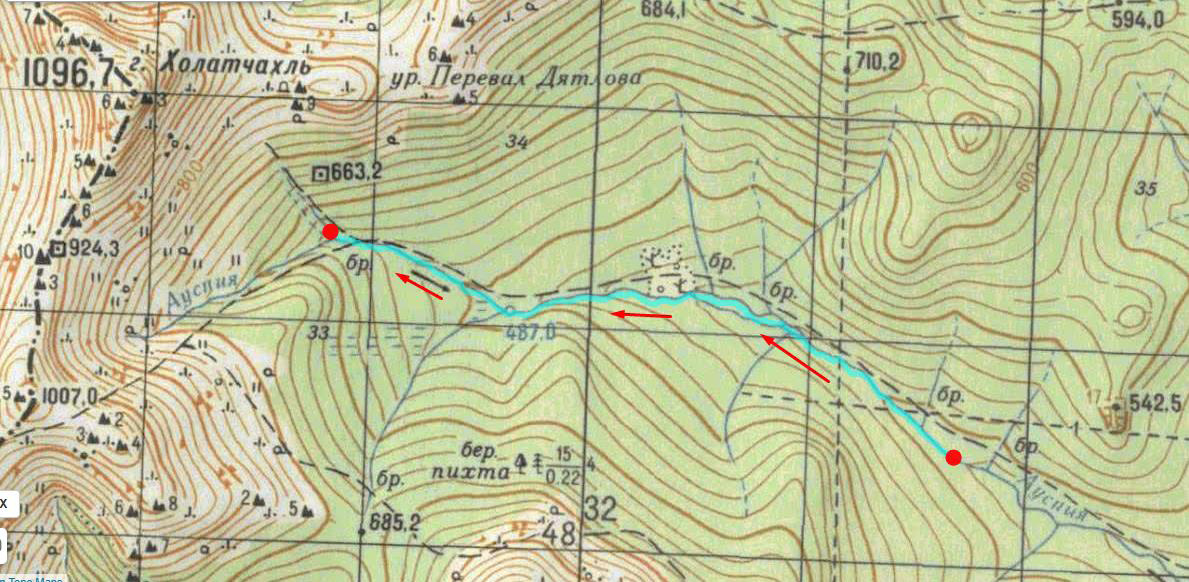
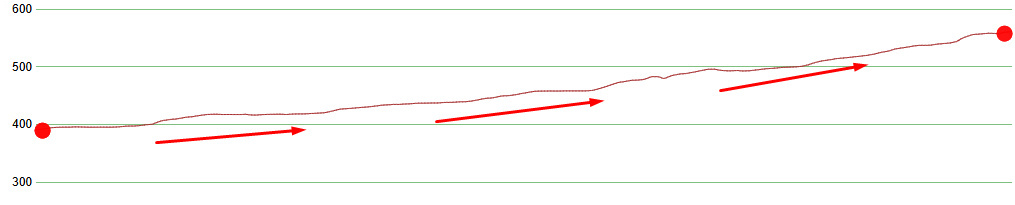
The difference in altitude is approximately 170 meters:
Day 6. January 25.
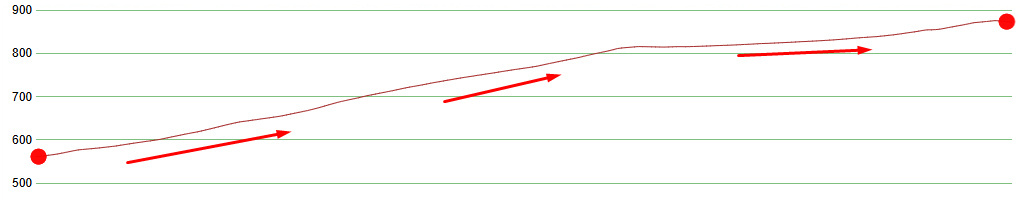
In the morning, we search for the location of the Dyatlov group's cache (no one has found it since 1963) and set out late (like the Dyatlov group). We climb to the Boot Rock and to the site of the Dyatlov group's tent on the northeastern slope of Kholat Syakhl. It's only 2.5 km. We level the area and pitch the tent using snow anchors. We reduce the tent's windage by cutting the central pole and lining it with snow blocks. We prepare for an overnight stay without a stove. This is the shortest section of the entire hike, but it has the greatest elevation change. We ascend the pass.
Each person adds a little dry firewood, prepared the night before, to their sleds. We also carry three five-liter jugs of heated water.
We travel on skis. Backpack in the sled. The sled is hitched behind. The climb will take 2 to 3 hours, depending on the morning snow crust.
This is exactly the section I walked in winter.
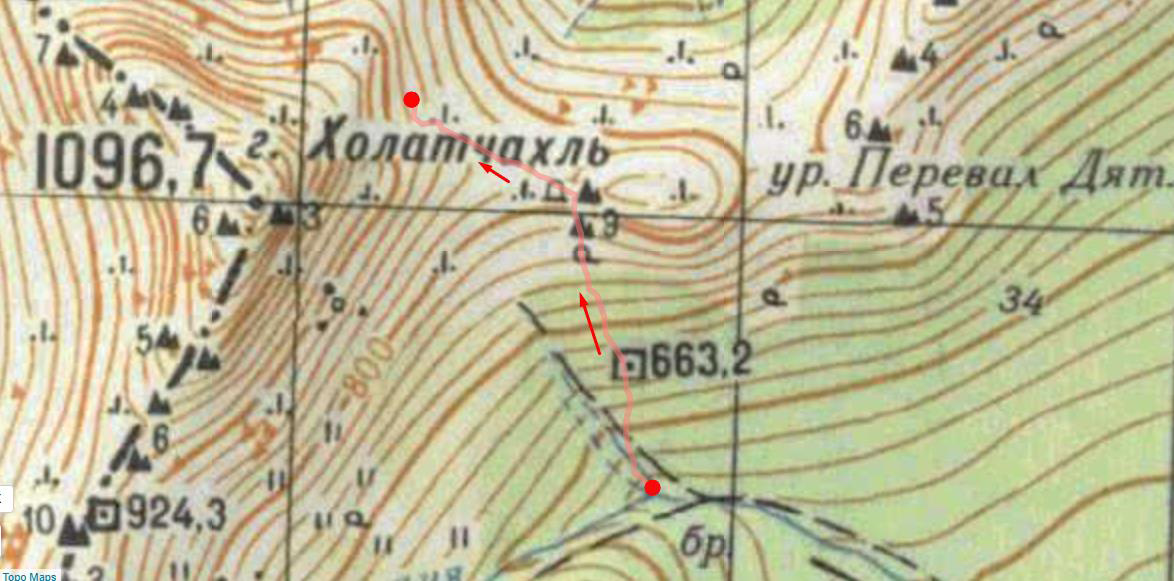
The difference in altitude is approximately 320 meters:
This section of the route can be seen in the video: https://youtu.be/MqghOfdcj3w
- 4 -
Day 7. January 26.
Weather permitting, those interested can climb Kholat Syakhl. Participants ascend and descend as a group under a designated leader for this ascent. The leader is appointed by the expedition leader.
The radial hike to Otorten (18.5 km one-way, 37 km round-trip) in 2026 is canceled due to the participants' poor technical preparation. This decision may be changed by the leader on site, based on weather conditions, the participants' condition, and other factors.
Participants can visit the famous, infamous cedar and stream where the Dyatlov group were found in 1959… The group descent and ascent are under the full supervision of the expedition leader.
Also, camp can be dismantled and lowered to a lower location, closer to the forest, in the morning. The leader will make this decision based on the participants' condition and weather conditions.
We will decide what clothing each participant will wear based on the weather.
As an example, the elevation gain from the tent location to Otorten:
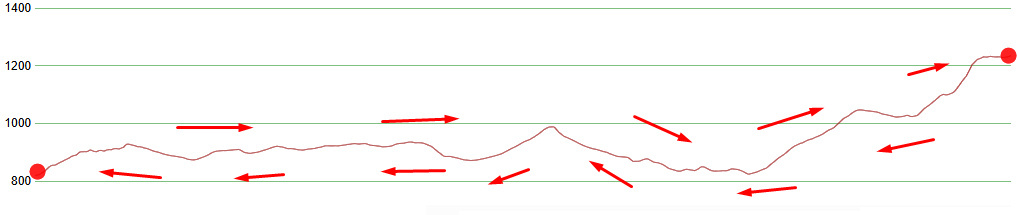
The elevation gain is uneven. Climbs alternate with descents. The total elevation gain in that direction is 416 meters, but the actual elevation gain is twice that.
Exact route details from the tent location to Otorten:
| Max elevation: | 1235 |
| Min elevation: | 819 |
| Start elevation: | 819 |
| Finish elevation: | 1235 |
| Start to finish elevation change: | 416 |
| Avg / Max ascent inclination: | 4 / 21° |
| Avg / Max descent inclination: | 3 / 12° |
| Total ascent: | 798 |
| Total descent: | 383 |
| Distance: | 18.4 km |
Day 8. January 27.
A rest day.
You can try experimenting with a snow cave, starting and maintaining a fire near a cedar, etc.
In the evening, we'll return to the tent and camp.
We'll decide what clothing we'll wear based on the weather.
Those who are very tired can stay put on Days 7 and 8, resting and recuperating.
Day 9. January 28.
The hike to the Chaikonur Pass (below the pass) is 13 km.
This hike is planned on a snowmobile trail. We travel in a boot with a sled. The backpack is in the sled. The skis are tied to the sled, on top of the backpack. Those who wish can ski. The sled with the backpack is hitched to the back. Even without snow, it's very difficult to navigate on a snowmobile. It won't be possible to move quickly.
If there's a snowfall overnight and not a single snowmobile passes afterward (and they often travel back and forth in that area), we ski. We take turns tracking. The backpacks are in the sled.
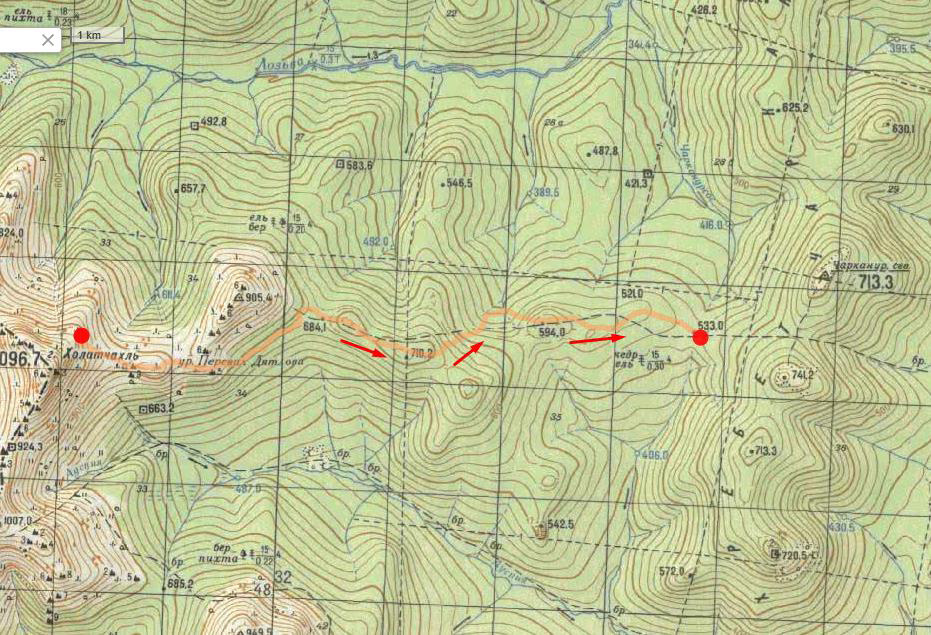
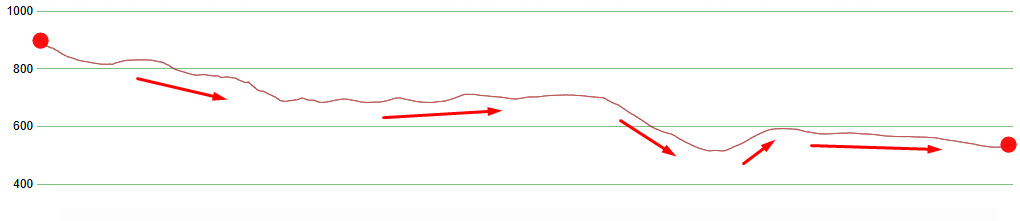
We will lose 360 meters in altitude:
- 5 -
Day 10. January 29.
The hike to Ilyich's hut is 11 km.
This hike is planned on a snowmobile trail. We'll travel in a boot with a sled. The backpack is in the sled. The skis are tied to the sled, over the backpack. Those who wish can ski. The sled with the backpack is hitched behind it.
If there's a snowfall overnight and not a single snowmobile passes afterward (and they often travel back and forth in that area), we'll ski. We'll take turns tracking. The backpacks are in the sled.
Even without snow, a snowmobile is very difficult to navigate. Moving quickly won't be possible.
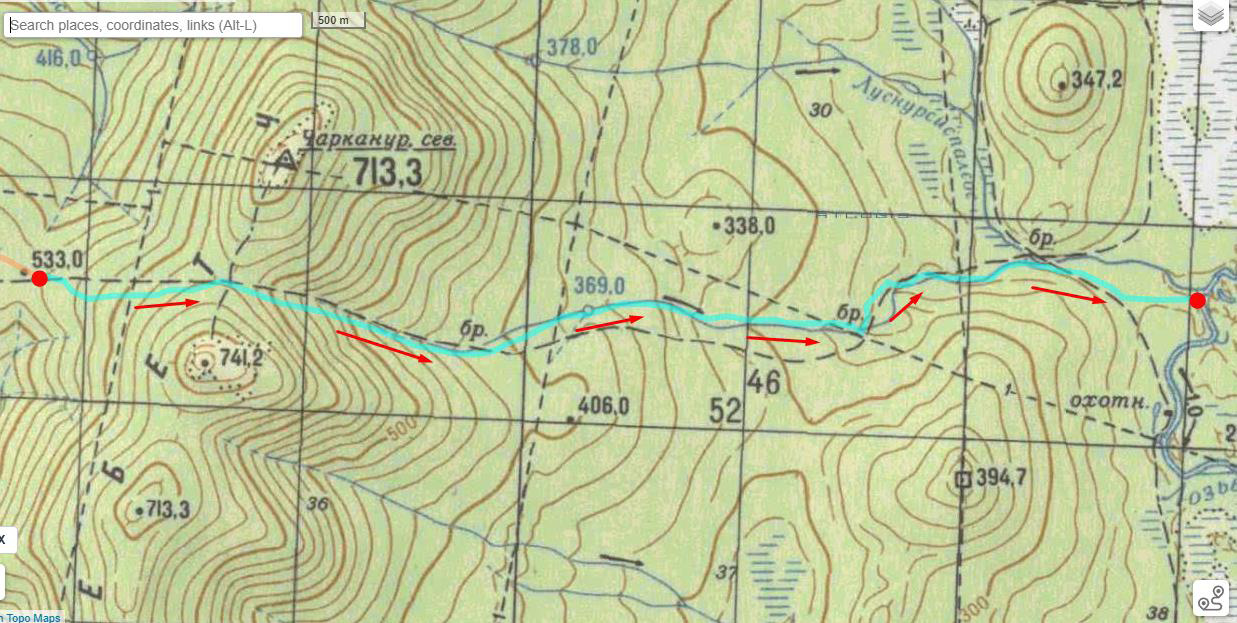
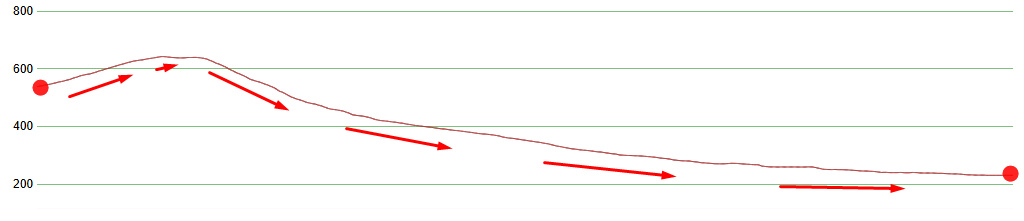
The altitude climb is 100 meters to the pass, then a descent with a loss of 412 meters:
Day 11. January 30.
The hike to Ushma.
This 32 km hike is planned to be done on a snowmobile trail. We'll be traveling in a boot with a sled. The backpack is in the sled. The skis are tied to the sled, on top of the backpack. Those who prefer can ski. The sled and backpack are hitched behind it.
The snowmobile trail on this section is very well-trodden. It will be one and a half times faster than the previous two days.
If there's a snowfall overnight and not a single snowmobile passes afterward (and they often travel back and forth in that area), we'll ski. We'll take turns making the trail. The backpacks are in the sled. However, there's a good chance that snowmobiles will show up during the day and make a trail.
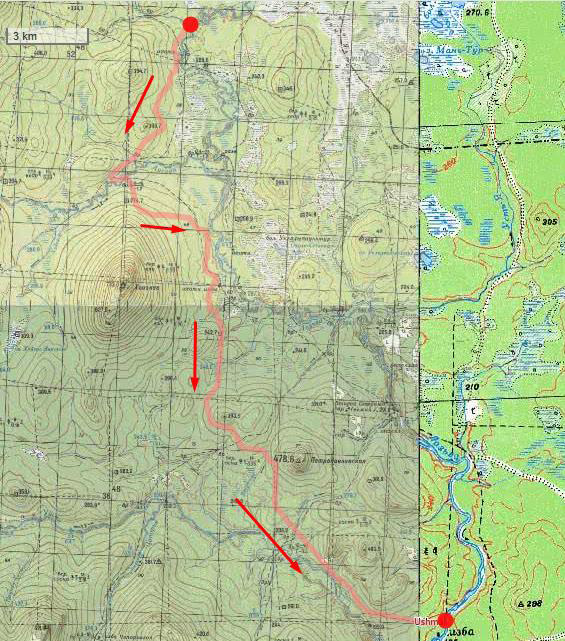
Olga and I covered this 32-kilometer section of the route in 2023, taking 10 hours with heavy sleds.
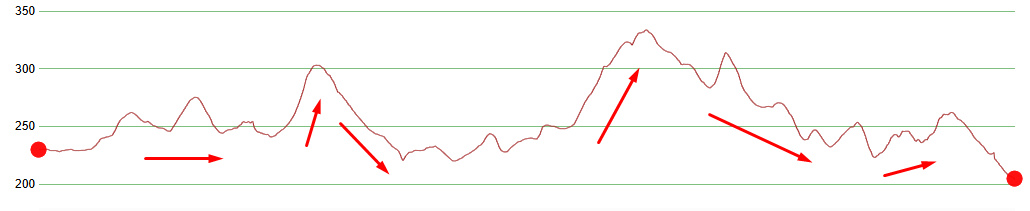
Another option is to walk two-thirds of this section along the Lozva River without any elevation changes (we already walked here on the first two days of the hike), but this will add about 8 kilometers to the distance. The guide will decide exactly where to go on site, based on the conditions.
We spend the night in Valery Anyamov's hut for a fee. Facilities include a large Mansi stove and bunks. There's a Mansi bathhouse nearby for a fee.
Both the hut and the bathhouse must be booked in advance, as the owner needs to heat them.
Day 12. January 31.
Transfer by GAZ-66 to Ivdel. Board the train in the evening.
Day 13. February 1.
Arrive in Yekaterinburg in the morning. In the afternoon, you can attend a conference in memory of the Dyatlov group.
Related articles
 Expedition January 2026


