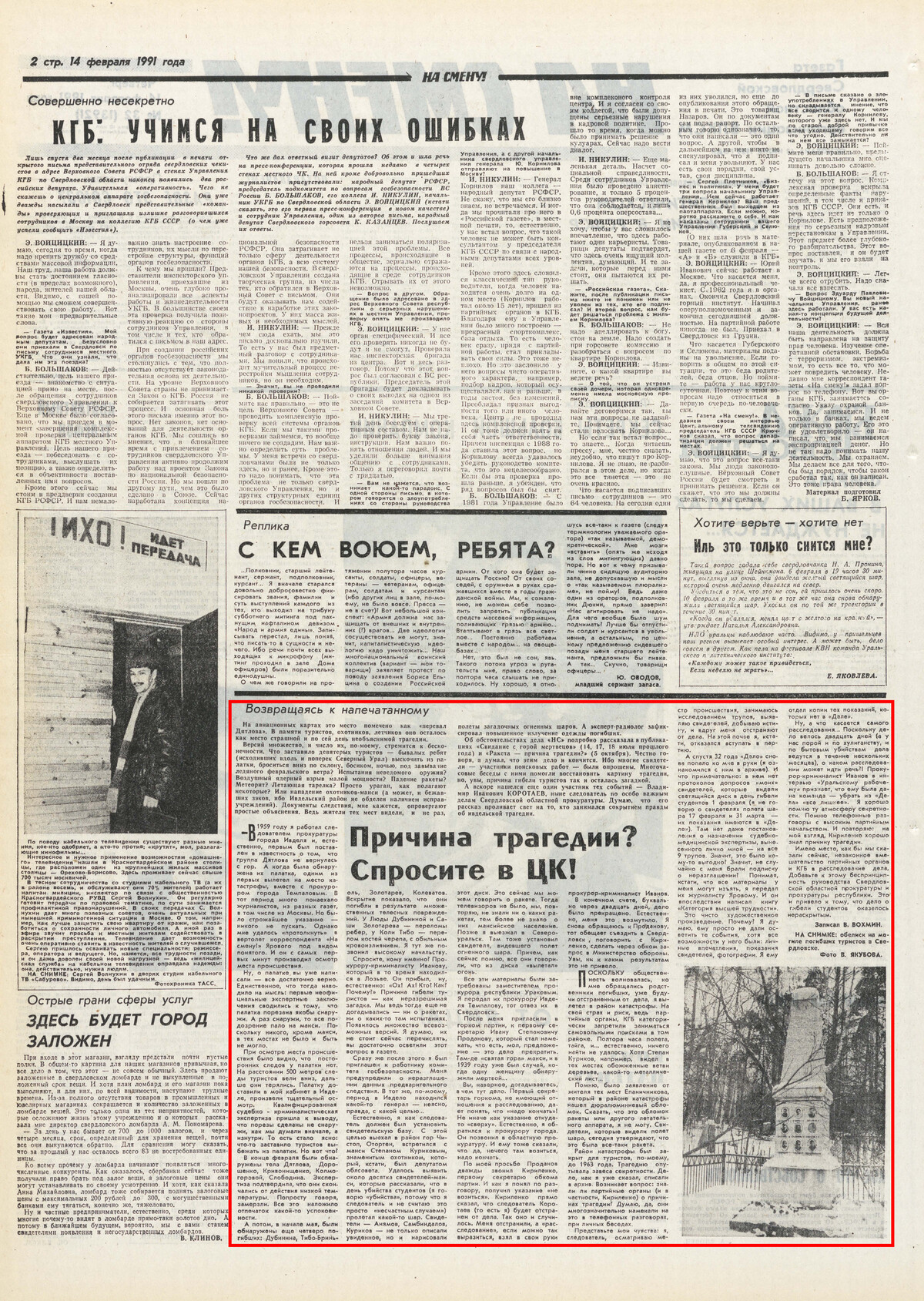
"The cause of the tragedy? Ask the Central Committee!"
14-02-1991

On aviation maps, this place is marked as "Dyatlov Pass." In the memories of hikers, hunters, and pilots, it remains the site of a terrible tragedy that remains unexplained to this day.
Theories abound, and their number, in my opinion, approaches infinity. What compelled nine seasoned hikers who had traveled the length and breadth of the Northern Urals to abandon their tent and rush down the slope, barefoot, at night, under the howling of an icy February wind? A test of an unknown weapon? A low-yield nuclear explosion? A missile crash? A meteorite? A flying saucer? A simple hurricane, as some believe? Or an attack by Mansi hunters (or perhaps escaped prisoners, since the Ivdel District is not without its share of correctional facilities). The investigative documents, it seems to me, refute simple explanations. After all, local residents had seen, repeatedly, the mysterious fireballs flying. And a radiologist recorded increased radiation levels in the victims' clothing.
NS covered the circumstances of the case in detail in the publications "A Date with the Mountain of the Dead" (July 14, 17, and 18 last year) and "A Rocket – the Cause of the Tragedy?" (October 5). Frankly, I thought that would be the end of it. Many witnesses—participants in the search and rescue operations—were interviewed. Hours of conversations with them helped piece together the tragedy, but, alas, the cause of the hikers' deaths remains a mystery.
Soon, another participant in those events was discovered: Vladimir Ivanovich Korotaev, now an investigator for particularly important cases at the Sverdlovsk Regional Prosecutor's Office. I think his story sheds light on who was responsible for concealing the truth about the Ivdel tragedy.
In 1959, I worked as an investigator for the Ivdel prosecutor's office and, naturally, was the first to be informed that the Dyatlov group had not returned from the mountains. And when their tent was discovered, I was one of the first to fly to the crash site, along with the city prosecutor, Tempalov. At that time, many journalists arrived, from various newspapers, including those from Moscow. But there were strict orders – no one was to be allowed in. However, I managed to "push" Yarovoy, a correspondent for "Na Smenu!", onto the helicopter under the guise of a witness. And he was inspecting the scene from the very first minutes.
Well, you've already written about the tent – it's all quite accurate. The only thing that gave me pause was that the first unofficial expert opinions concluded that the tent had allegedly been cut on the outside. And since it was outside, all suspicion fell on the Mansi. Since no one else but the Mansi had been in those parts, nor could there have been.
Upon inspection of the scene, it was clear that there were no traces of anything else near the tent. For 500 meters, the hikers' tracks led downwards, but beyond that, they disappeared. The tent was delivered to my office in Ivdel, where a thorough examination was conducted. A qualified forensic expert concluded that the cuts were made not from the outside, as we initially thought, but from the inside. So it became clear: something had forced the hikers to flee the tent. But what?
At the end of February, the bodies of Dyatlov, Doroshenko, Krivonischenko, Kolmogorova, and Slobodin were discovered. The examination confirmed that they died from exposure to low temperatures. Simply put, they froze to death. All this left an impression of some kind of calm.
- 2 -
Then, in early May, four more victims were discovered: Dubinina, Thibault-Brignolle, Zolotarev, and Kolevatov. Autopsies revealed they died from multiple injuries. Lyuda Dubinina and Sasha Zolotarev suffered broken ribs, and Kolya Thibault suffered a skull fracture with hemorrhaging. I immediately called the higher-ups.
Ask who exactly? Forensic prosecutor Ivanov, who was in Lozva at the time. He arrived, and naturally, he said, "Oh! Who? How? Why?" The cause of the hikers' deaths remains an unsolved mystery. We had no idea back then—no missiles, no testing of any kind. A multitude of possible theories emerged. I don't think there's any need to list them now; you've covered this issue sufficiently in the newspaper.
Immediately afterward, I was summoned to a KGB officer. I was warned about not disclosing the preliminary investigation. Around the same time, I believe, some general was in Ivdel—though it's unclear for what purpose...
Naturally, as an investigator, I had to establish a witness base. To this end, I traveled to the Chistop and Otorten mountains and met with Stepan Kurikov, a Mansi man known as a hunter and, incidentally, a member of the regional council. We managed to identify about a dozen Mansi witnesses who said that on the day of the students' murder (I say "murder" because I'm an investigator and don't consider it an "accident"), some kind of sphere flew past. The witnesses—Anyamov, Sambindalov, and Kurikov—not only described what they saw but also drew a picture of the disk. Now we can talk about a missile. Back then, there were no televisions, and I repeat, we knew nothing about any missiles, much less the Mansi population. Later, I went to Severouralsk. There, too, I located a witness who saw the fireball fly. Moreover, as I recall, they all said that fire was "flying" out of the disk.
All these materials were requested by the Deputy Prosecutor of the Republic, Urakov. I passed them on to the Prosecutor of Ivdel, Tempalov, who took them to Sverdlovsk...
Afterwards, I was invited to the City Party Committee, to First Secretary Ivan Stepanovich Prodanov, who began hinting that there was a proposal to drop the case. It was said to be the "holy mountain" of the Mansi, and in 1939 there had already been a case where a woman was found dead...
You can probably guess what this is all about. The first secretary of the city party committee, who had no connection to the investigation, made it clear that "it must be finished!" This must be an order from somewhere "higher up." Naturally, I contacted the city prosecutor. He called the regional prosecutor's office. And he, too, was told that yes, there was no point in messing around there; it had to be finished.
At my request, Prodanov twice called Kirilenko, the first secretary of the regional party committee. And as I understood from the conversation, he received orders "not to mess around." Kirilenko bluntly stated that investigator Korotayev (me, that is) would be removed from the case. And so it happened. I was removed, and the "investigation," so to speak, was taken over by prosecutor-criminalist Ivanov.
Ultimately, literally twenty days later, the case was closed. Naturally, this outraged me. I contacted Prodanov again, and he promised to go to Sverdlovsk, talk to Kirilenko, and submit a request through the regional committee to the Ministry of Defense. Unfortunately, this didn't produce any results.
- 3 -
Since the public was worried, and relatives of the victims approached me, even after being removed from the case, I flew to the crash site. It was at my own risk, as the Party and the KGB had categorically forbidden any unauthorized searches in the area. An hour and a half's flight, through the taiga, and... naturally, nothing was found. Although Stepan Kurikov, for example, saw charred tree branches and some kind of metal sheet in the area.
I remember a statement from a local resident, Yepanichnikov, who found a duralumin fragment in the crash site. I can't say whether it was a rocket or other aircraft fragment. Witnesses who saw the balloon fly claim today that it was, in fact, a rocket.
The crash site was closed to hikers, I believe, until 1963. The tragedy was shrouded in secrecy. The case, as I already said, was consigned to the archives. The question arises: did the party organs (and Kirilenko in particular) know the cause of death? I think so; they hinted at it heavily in telephone conversations and in person.
Imagine my feelings: I'm an investigator, examining the crime scene, examining the bodies, identifying witnesses, uncovering the truth, and suddenly I'm removed from the case. Incidentally, I refused to join the party for this reason.
And 32 years later, the "Case" has come into my hands again (I read it in the archives). And what's remarkable is that it doesn't contain the interrogation transcripts of "my" witnesses who saw the luminous disk on the day of the students' deaths, February 1st (I'm not talking about the witnesses to the balloon flights on February 17th and March 31st—their testimony is included in the "Case"). There's not even a ruling ordering a forensic medical examination, issued personally by me—for all nine bodies. So, was this something that benefited someone? So, it's no coincidence that they made me sign a non-disclosure agreement? Realizing, incidentally, that all my materials could be confiscated, I handed them over to journalist Yarov. He subsequently wrote a book, "Category of the Highest Difficulty."
This is purely a work of fiction. Why? I think he was simply prevented from covering those events, even though he had every opportunity: personal impressions, witness statements, photographs. I gave him copies of the testimony that isn't in the "Case."
Well, as for the investigation itself... Since the case lasted twenty days (and here, cases involving hooliganism and domestic murders sometimes take months), what kind of investigation can we even talk about?! In an interview with Uralsky Rabochy, criminal prosecutor Ivanov admits that he was ordered to remove "everything unnecessary" from the case. I remember that atmosphere of secrecy well. I recall telephone conversations with high-ranking party officials. And I repeat: in my opinion, Kirilenko knew the cause of the tragedy well.
There was, as we would say today, illegal interference by party organs and the KGB in the investigation. Add to this the unscrupulous leadership of the Sverdlovsk Regional Prosecutor's Office and the republican prosecutor's office. This is what led to the students' deaths remaining unsolved.
Recorded by V. Vokhmin.
"Na Smenu!" (February 14, 1991)